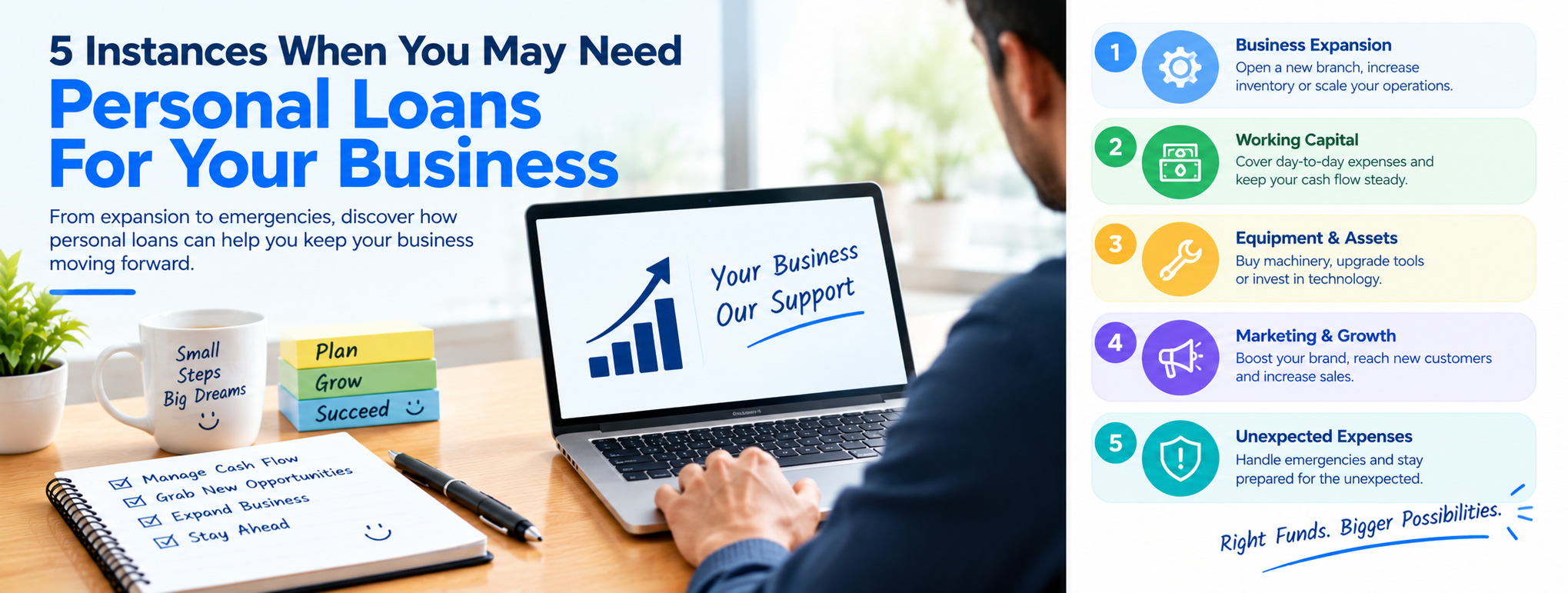
Running a business in India means living with uneven cash flow. A big client pays sixty days late, a supplier offers a bulk discount that ends on Friday, or a machine breaks down just before the festive season. In each case, the money you need isn't in the account, but the opportunity (or the problem) is very real.
A regular business loan is the obvious answer, but it isn't always within reach. Many lenders ask for two to three years of business vintage, GST filings, audited financials and sometimes collateral. If you are a first-time entrepreneur, a freelancer or the owner of a small shop, that paperwork can slow you down or shut you out completely.
That's why many owners look at a personal loan for business: an unsecured loan taken in your own name, based on your income and credit profile, that you put to work in your venture. In this guide, we cover five situations where it makes sense, how it compares with a business loan, what lenders check, how to apply, and how to borrow responsibly.
What Is a Personal Loan for Business?
A personal loan for business isn't a separate product category. It is a regular unsecured personal loan that you use to fund business needs. Because approval rests on your personal income, repayment history and credit score rather than on business financials or collateral, the process is usually faster and the documentation lighter. You receive a lump sum, repay it through fixed monthly EMIs over a set tenure, and, with most lenders, you don't have to justify how each rupee is spent.
This is especially useful when you need a personal loan for small business purposes. Micro-enterprises, sole proprietors, home-based sellers, consultants and shop owners often have real income that is hard to document the way a bank's business loan desk prefers. A personal loan lets them borrow against their own repayment capacity, without pledging property, stock or machinery.
One caveat before we go further: some lenders specify permitted end-use in their loan agreement. Always read the terms and confirm that business use is allowed before you apply.
5 Instances When a Personal Loan for Business Makes Sense
1. Startup Capital
Every business spends before it earns. Registration, a basic website, first-batch inventory, packaging, a small workspace deposit and launch marketing all need cash on day one. Banks usually want to see a track record before lending, and a brand-new venture doesn't have one.
That gap is where a personal loan to start a business can help. Since the lender evaluates you rather than the business idea, a steady income and a healthy credit score can be enough to unlock funds.
Take a salaried professional who wants to start a weekend home-baking brand. A few thousand rupees for ingredients, boxes and a food-photography session can be enough to launch, test demand and collect the first orders. There's no need to wait years for a business loan.
Tip: Size the loan to launch essentials, not the full dream. A lean start keeps your EMI light while revenue builds.
2. Working Capital
Profit on paper doesn't pay salaries; cash does. Late customer payments, seasonal slowdowns and sudden supplier price hikes can leave a healthy business short of cash for a few weeks. A personal loan for working capital can cover that gap so operations don't stall.
You can use it to pay staff and rent, restock inventory, clear utility bills or settle vendor dues on time. Paying vendors promptly also protects your relationships and can help you negotiate better terms later.
Working capital needs are usually temporary, so a shorter tenure often makes sense. You repay in line with your receivables and pay less interest overall. If you're weighing this route, our guide on how to apply for a short-term loan in India walks through the process step by step.
3. Equipment, Technology and Everyday Business Expenses
To stay competitive, a business has to keep investing: a better laptop, a new printer, a POS machine, accounting software, a commercial mixer, a second-hand scooter for deliveries. Many of these purchases are too small to justify a formal equipment loan, yet too big to absorb from monthly cash flow.
A personal loan for business expenses fits these needs neatly. It can also cover recurring costs such as digital advertising, packaging, licences, repairs and professional fees. Because the loan is unsecured, you don't have to pledge the equipment or any business asset to buy it.
A useful test before you borrow: will this purchase help me earn more, save time or reduce costs? If the answer is yes, the loan can pay for itself. If it's "nice to have", it's better to wait.
4. Business Expansion and Bridge Financing
Growth rarely waits for a convenient time. A shop next door is vacant. A supplier offers a heavy discount on bulk stock. Festive demand is around the corner. A new city opens up for your product. These are time-sensitive moments where slow financing means a lost chance.
A personal loan for business expansion can work as bridge financing here. You use it to seize the opportunity now and repay from the additional revenue it generates. Typical uses include a new outlet deposit, additional hires, a bulk inventory purchase or a marketing push into a new market.
Speed is the main advantage. If you need funds quickly, this guide on how to get a cash loan online quickly explains what to prepare so approval and disbursal aren't delayed.
A word of caution: for very large expansions, a dedicated business loan or a government-backed MSME scheme may offer larger amounts at lower rates. Personal loans work best for incremental, well-planned growth steps.
5. Consolidating Business Debt
Many small businesses accumulate debt in pieces: a credit card balance here, a supplier's credit there, a small informal loan somewhere else. Each has its own due date, and some carry high interest. Tracking them all becomes a job in itself, and one missed payment can dent your credit score.
Using a personal loan to consolidate these dues into a single EMI can simplify your finances. When the new loan's interest rate is lower than the average of what you're paying now, you may also save money.
The rule here is to compare total repayment cost, not just the monthly EMI. A longer tenure lowers your EMI but can raise the total interest paid. And consolidation only works if you stop adding new expensive debt after clearing the old ones.
Business Loan vs Personal Loan: Which One Should You Choose?
Understanding the difference between a business loan vs personal loan helps you pick the right tool. Here's a general comparison (exact terms vary by lender):
| Factor | Personal Loan | Business Loan |
|---|---|---|
| Approval based on | Your income and credit score | Business financials, vintage and turnover |
| Collateral | Usually none (unsecured) | Often required for larger amounts |
| Documentation | Minimal KYC and income proof | GST returns, ITR, balance sheets, business proof |
| Approval speed | Fast, often digital | Slower, more verification |
| Loan amount | Small to mid-sized | Small to very large |
| Interest rate | Generally higher | Generally lower, especially if secured |
| Best for | New or small businesses, urgent needs | Established businesses, large investments |
A simple rule of thumb: if you need a modest amount quickly, or your business is too new to show a track record, a personal loan is often the practical choice. If you need a large sum for a long-term investment and can show business financials, a business loan is usually cheaper.
Benefits and Risks of Taking a Personal Loan for Business
Benefits
- No collateral: Your property, stock and equipment stay untouched.
- Quick access: Online applications and digital KYC speed up the process.
- Flexible use: You decide where the money goes, from inventory to marketing.
- Fixed EMIs: Predictable repayments make monthly budgeting easier.
Risks
- Higher interest: Unsecured loans usually cost more than secured business loans.
- Personal liability: The loan is in your name, so a business slump doesn't reduce your obligation.
- Credit score impact: Late or missed EMIs can hurt your score and limit future borrowing.
- Over-borrowing: Easy access can tempt you to borrow more than the business can service.
Before you commit, read our breakdown of the pros and cons of applying for an online personal loan so you know exactly what you're signing up for.
Eligibility and Documents Required
Criteria vary by lender, but most ask for the following:
- Indian resident, generally aged 21 to 58 or 60
- A steady source of income (salaried or self-employed)
- A good credit history and a satisfactory credit score
- An active bank account
Documents usually needed:
- PAN card and Aadhaar for KYC
- Recent bank statements as income proof
- Address proof
- A selfie or video KYC, depending on the lender
Your credit score plays a big role in approval and pricing. If you're unsure where you stand, check the minimum CIBIL score for a personal loan. If your score is on the lower side, don't give up: this guide on getting a personal loan with a low credit score explains your options.
How Much Should You Borrow and What Will It Cost?
Start with the exact amount your business needs and can repay. Small-ticket options such as a ₹1,000 personal loan or a ₹5,000 personal loan are handy for immediate, short-term needs like restocking, a repair bill or a small marketing spend, without the burden of a large EMI.
Before you apply, calculate your EMI so there are no surprises. Many lenders prefer that all your EMIs together stay within roughly 40–50% of your monthly income. Our personal loan EMI calculator guide shows how amount, interest rate and tenure change your monthly payment and total interest.
Also look beyond the interest rate. Check processing fees, late payment charges, prepayment terms and GST on fees so you know the real cost of borrowing.
How to Apply for a Personal Loan for Business: Step by Step
- Define the need. Write down what the money is for and how it will generate returns.
- Check your credit score. Fix errors and clear small overdue amounts if you can.
- Calculate the EMI. Make sure it fits comfortably within your monthly cash flow.
- Compare lenders. Look at rates, fees, tenure options and reviews, and confirm the lender allows business use.
- Apply online and complete KYC. Upload your documents, verify your identity and submit.
- Review the terms and accept. Read the agreement carefully before the amount is disbursed to your bank account.
Ready to take the next step? Apply in a few minutes.
👉 Apply for a Personal Loan Now
Smart Tips to Use a Personal Loan for Business Responsibly
- Borrow for growth, not for losses. Loans that build revenue are easier to repay than loans that only plug a leak.
- Keep business and personal money separate. A dedicated business account makes tracking and repayment cleaner.
- Match tenure to purpose. Short-term needs deserve short tenures.
- Build a small buffer. Keep an emergency reserve so a slow month doesn't lead to a missed EMI.
- Prepay when you can. If your lender allows it without heavy charges, clearing the loan early reduces total interest.
Frequently Asked Questions
Can I use a personal loan for business purposes?
In most cases, yes, since many personal loans have no end-use restriction. Still, check your lender's terms to confirm that business use is permitted.
Is a personal loan better than a business loan for a new business?
Often it is, because a new business lacks the vintage and financial records a business loan requires. A personal loan is based on your income and credit score instead. If you need a large amount, though, a business loan may be cheaper once you qualify.
Will a personal loan for business affect my credit score?
Timely EMIs can improve your credit profile over time, while late or missed payments can damage it. Since the loan is in your name, its repayment history appears on your personal credit report.
How quickly can I get the money?
Many online lenders process applications and disburse funds quickly once KYC is complete. Timelines depend on the lender and the completeness of your documents.
Conclusion
A personal loan for business isn't a replacement for every kind of business financing, but in the right situations it is a fast, flexible and collateral-free option. It can fund your startup, smooth out working capital gaps, pay for equipment and everyday expenses, support expansion when timing matters, and simplify scattered business debt into one manageable EMI.
The key is to borrow with a plan. Know exactly what the money will do, calculate your EMI before you commit, compare the total cost, and read the terms carefully. Used wisely, a personal loan can give your business the push it needs without putting undue pressure on your finances.
If you're ready to move forward, FixRupee makes it simple to explore your options and apply online.