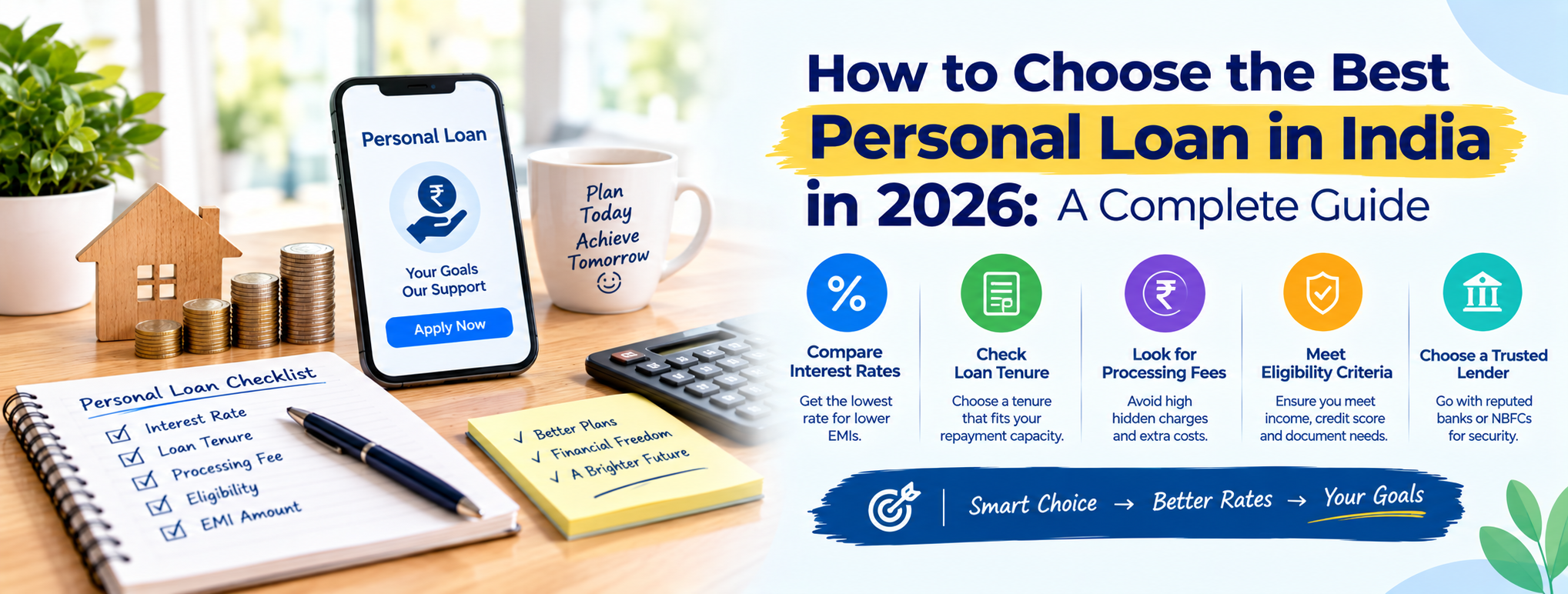
Looking for the best personal loan in India? Compare interest rates, fees, eligibility and EMIs, and learn how to get approved fast in 2026.
It is the middle of the month. Your rent is due, a family medical bill has landed, and your salary is still two weeks away. Sound familiar? Millions of Indians face this squeeze every year, and many reach for the first loan offer they see. That is where costly mistakes begin.
Finding the best personal loan in India is not about chasing the lowest advertised rate. It is about the full picture: interest, fees, tenure, flexibility and how quickly the money reaches you. A loan that looks cheap on an app can cost thousands more once hidden charges show up.
This guide shows you how to choose the best personal loan in 2026. You will learn how rates work, who qualifies, which documents you need, how to compare banks and NBFCs, and how to avoid common traps. Whether you work at a tech park in Whitefield, run a small business in Jayanagar, or freelance from home, the steps are the same.
The best personal loan in India is one with a low total cost (interest plus fees), an EMI that fits within 30–40% of your monthly income, a tenure that suits your cash flow, and transparent terms with no surprise charges.
If you want a head start, you can check your options on FixRupee while you read.
What Is a Personal Loan?
A personal loan is money you borrow from a bank, an NBFC (non-banking financial company) or a digital lender, and repay in fixed monthly instalments called EMIs. It is usually an unsecured personal loan. That means you do not pledge a house, gold or any other asset as security.
Because the lender takes more risk, the interest rate is higher than for a home loan or a loan against property. Approval depends mainly on your income, job stability, existing debts and credit score.
People use personal loans for many reasons:
- Medical emergencies
- Home repairs and renovation
- Education and skill courses
- Weddings and family events
- Debt consolidation
- Business cash-flow gaps
- Travel and relocation
See a few real use cases in our guides on online personal loan for home renovation and personal loan for medical emergency.
Why Choosing the Right Personal Loan Matters in 2026
The personal loan in India market has grown fast. Retail credit has expanded strongly over the last few years, and unsecured lending has been among its fastest-growing parts. Digital lending has made borrowing easier, but easy is not the same as cheap.
The Reserve Bank of India (RBI) has also tightened its watch on unsecured credit. Lenders have become more careful, which means weak applications are rejected more often. Regulations now push lenders to disclose the Key Fact Statement (KFS), which lists the annual percentage rate (APR), all fees and the total repayment amount. Use it. It is your best tool for comparing offers honestly.
Here is why a careful choice pays off:
- Lower total cost. A 3–4% difference in rate can save tens of thousands of rupees.
- Better credit health. Timely EMIs on the right loan build your score.
- Less stress. A comfortable EMI keeps your monthly budget safe.
- Fewer surprises. Clear fees and prepayment terms avoid nasty bills later.
Example: Take a ₹5,00,000 loan for 3 years. At 12% per year, your EMI is about ₹16,607 and you pay roughly ₹98,000 as interest. At 16%, the EMI is about ₹17,579 and the interest is nearly ₹1,33,000. That is a gap of about ₹35,000 for the same loan amount.
Step-by-Step: How to Choose the Best Personal Loan in India
Follow these seven steps. They work as a simple checklist you can save and reuse.
- Decide how much you really need. Borrow only what you need, not the maximum offered.
- Check your credit score. Know where you stand before you apply.
- Compare lenders. Look at banks, NBFCs and digital platforms side by side.
- Check the total cost. Add interest, processing fees, GST and other charges.
- Pick a sensible tenure. Balance EMI size against total interest.
- Read the foreclosure and prepayment terms. Know your exit cost.
- Apply once, with the right documents. Avoid multiple hard enquiries.
Let us go through each one in detail.
Step 1: Know How Much You Need and Can Afford
Lenders may approve more than you need. Do not accept it blindly. A bigger loan means a bigger EMI and more interest.
A useful rule from financial planners: your total EMIs, including home, car and credit card dues, should stay within 40% of your monthly take-home income. Many lenders use a similar measure called the Fixed Obligation to Income Ratio (FOIR) when they decide your personal loan amount eligibility.
Quick affordability check:
- Monthly take-home income: ₹80,000
- Existing EMIs: ₹12,000
- Safe total EMI limit (40%): ₹32,000
- Room for a new EMI: about ₹20,000
Use a personal loan EMI calculator before applying. Our personal loan EMI calculator complete guide 2026 explains how to use one and what the numbers mean.
What Is a Personal Loan EMI?
Your personal loan EMI is the fixed amount you pay every month. It includes part principal and part interest. In the early months, more of the EMI goes toward interest. Later, more goes toward principal.
The EMI formula is:
EMI = P × r × (1 + r)^n ÷ [(1 + r)^n − 1]
Here P is the loan amount, r is the monthly interest rate (annual rate ÷ 12 ÷ 100) and n is the number of months.
Step 2: Check Your Credit Score First
Your credit score is the single biggest factor in the rate you get. In India, the best known score is the CIBIL score, which ranges from 300 to 900. Experian, Equifax and CRIF High Mark also provide scores.
Personal Loan Credit Score Requirements
| Score range | What it usually means |
|---|---|
| 750 and above | Strong. Best chance of approval and lowest rates |
| 700–749 | Good. Approval likely, rates may be slightly higher |
| 650–699 | Fair. Approval possible, often at higher rates |
| Below 650 | Weak. Many lenders decline or charge a premium |
Most banks prefer a score of 700 or more, and the top rates generally go to scores above 750. Treat these bands as general guides, since each lender sets its own policy.
Learn more in our guide on the minimum CIBIL score for personal loan.
Personal Loan With Low CIBIL Score: Is It Possible?
Yes, but it costs more. Some NBFCs and fintech lenders look beyond the score. They may check your bank statements, salary credits and job profile. Expect a higher rate and a smaller amount.
If your score is low, try these steps before applying:
- Pay all overdue EMIs and card bills.
- Reduce credit card usage below 30% of your limit.
- Check your credit report for errors and raise a dispute if you find any.
- Avoid applying to many lenders at the same time.
- Consider a smaller loan or a co-applicant with a strong profile.
Read more in our detailed article on a personal loan with low credit score.
Step 3: Compare Banks, NBFCs and Digital Lenders
There is no single winner for everyone. The best bank for personal loan in India for a salaried employee with a high score may not be the best choice for a freelancer with irregular income. Here is how the three main lender types differ.
Banks (Public and Private)
Pros:
- Usually the lowest interest rates
- Strong trust and regulation
- Higher loan amounts for good profiles
Cons:
- Stricter eligibility
- Slower paperwork at some branches
- Pre-approved offers mostly for existing customers
NBFCs
A personal loan from NBFC lenders is often easier to get. NBFCs are regulated by the RBI and many have fast, app-based processes.
Pros:
- Faster approvals
- More flexible with lower scores and self-employed borrowers
- Quick disbursal, sometimes within hours
Cons:
- Interest rates are often higher
- Processing fees can be higher
Digital Lending Platforms
Loan marketplaces and apps let you view multiple offers at once. They save time and make personal loan comparison in India simple. Always confirm that the actual lender behind the offer is an RBI-regulated bank or NBFC.
Quick comparison:
| Feature | Banks | NBFCs | Fintech platforms |
|---|---|---|---|
| Typical interest rate | Lower | Medium to high | Depends on partner lender |
| Approval speed | 1–5 days | Hours to 2 days | Minutes to hours |
| Eligibility | Strict | Flexible | Flexible |
| Best for | High-score salaried | Mixed profiles | Comparing many offers |
Indicative ranges only. Always verify with the lender.
Step 4: Understand Personal Loan Interest Rates
Personal loan interest rates in India vary widely. As a broad guide, large banks often offer rates starting around 10–11% for top profiles, while NBFCs and fintech lenders can range from about 12% to over 30% for riskier borrowers. Actual rates change often, so always confirm the current rate with the lender.
What Decides Your Interest Rate?
- Credit score and credit history
- Monthly income and job stability
- Employer category (a large listed company or MNC often gets better terms)
- Existing loans and credit card dues
- Loan amount and tenure
- Your relationship with the lender
How to Find the Lowest Interest Rate Personal Loan
A lowest interest rate personal loan is usually reserved for borrowers who tick most of these boxes:
- Credit score above 750
- Stable job with a reputed employer
- Low existing debt
- Salary account with the same bank
To get a personal loan with low interest, compare at least three offers, negotiate using your credit profile, and check whether a pre-approved offer exists.
Flat Rate vs Reducing Balance Rate
This is a common trap. A flat rate charges interest on the full original amount for the whole tenure. A reducing balance rate charges interest only on the outstanding principal. A 9% flat rate is much more expensive than 9% reducing, and works out to roughly 16–17% on a reducing basis. Always ask for the APR, which shows the true yearly cost.
Step 5: Look at All Fees, Not Just the Rate
Two loans with the same interest rate can have very different costs. Check these charges.
Personal Loan Processing Fees
Personal loan processing fees typically range from about 0.5% to 3% of the loan amount, plus 18% GST. On a ₹5,00,000 loan, a 2% fee is ₹10,000 plus GST, which is ₹11,800 in total. Some lenders deduct it from the amount you receive, so your disbursal is lower than the sanctioned amount.
Other Charges to Watch
- Late payment penalty: Charged on missed or delayed EMIs
- Bounce charges: Applied when an EMI auto-debit fails
- Documentation or stamp duty charges: Vary by state
- Part-prepayment and foreclosure charges: Explained below
- Insurance add-ons: Optional in most cases, so do not accept them without asking
Personal Loan Foreclosure Charges and Prepayment Charges
Personal loan foreclosure charges apply when you close the whole loan before the tenure ends. Personal loan prepayment charges apply when you pay a large part of it early. Many lenders charge about 2–5% of the outstanding amount, and some do not allow prepayment in the first 6–12 months.
RBI rules in recent years have limited prepayment charges on floating-rate loans taken by individuals for non-business purposes. Most personal loans, however, carry fixed rates, so charges may still apply. Check the loan agreement and KFS before signing.
Tip: If you expect a bonus or windfall, choose a lender with low or zero prepayment charges.
Step 6: Choose the Right Repayment Tenure
Personal loan repayment tenure usually ranges from 12 to 60 months, and some lenders go up to 72 months.
| Tenure | EMI | Total interest | Best for |
|---|---|---|---|
| Short (12–24 months) | Higher | Lower | Stable income, want to be debt-free early |
| Medium (36 months) | Balanced | Moderate | Most salaried borrowers |
| Long (48–60 months) | Lower | Higher | Tight monthly budget |
A longer tenure feels easier each month but costs more overall. A good approach is to pick the shortest tenure whose EMI you can pay comfortably without stress.
If you only need money for a few months, a short-term product may fit better. See how to apply for a short term loan in India.
Personal Loan Eligibility Criteria
Every lender sets its own rules, but most follow a similar pattern.
Personal Loan for Salaried Employees
A personal loan for salaried employees is generally the easiest to get. Common criteria:
- Age: 21 to 60 years (some lenders go slightly beyond)
- Minimum monthly income: often ₹15,000 to ₹25,000, higher in metro cities like Bengaluru
- Work experience: at least 6 months to 1 year in the current job, and 1–2 years in total
- Employer: private company, public sector or government
- Credit score: usually 700 or more
Personal Loan for Self-Employed Individuals
A personal loan for self-employed individuals needs more proof because income can vary. Typical criteria:
- Age: 24 to 65 years
- Business vintage: at least 2–3 years
- Income tax returns for the last 2 years
- Bank statements showing steady inflows
- A healthy credit score and no major defaults
If you run your own business or work as a freelancer, read our guide on an instant personal loan for self-employed people. For business-related needs, see these 5 instances when you may need personal loans for your business.
Personal Loan Documents Required
Keeping your papers ready speeds up the personal loan approval process. Here is the usual list.
For salaried applicants:
- PAN card and Aadhaar card
- Address proof (passport, utility bill, rental agreement)
- Last 3 months' salary slips
- Last 3 to 6 months' bank statements
- Employee ID or offer letter (sometimes)
- Recent passport-size photograph
For self-employed applicants:
- PAN, Aadhaar and business address proof
- Business registration or GST certificate
- Income tax returns for 2 years
- Profit and loss statement and balance sheet
- Last 6 to 12 months' bank statements
Many digital lenders now use e-KYC, DigiLocker and account aggregator data, so you may not need to upload paper copies at all.
How to Apply for a Personal Loan Online (Step-by-Step)
You can apply for a personal loan online in minutes if your profile is strong. Here is the simple process.
- Check eligibility. Enter your income, city and basic details on a lender or marketplace site.
- Compare offers. Review rate, fees, tenure and APR for each.
- Choose your offer. Select the loan that offers the lowest total cost.
- Complete e-KYC. Verify with Aadhaar OTP and upload your PAN.
- Share income proof. Upload salary slips or bank statements, or link your account securely.
- Review the KFS and agreement. Read every fee before you accept.
- E-sign and set up auto-debit. Confirm your EMI mandate.
- Receive the money. Funds go directly to your bank account, often within 24 to 48 hours, and sometimes faster.
Instant Personal Loan Online: What to Know
An instant personal loan online can reach your account within minutes to a few hours. It is helpful in emergencies, but speed should never replace checking. Instant loans can carry higher rates and fees. Learn how to stay safe in our guide on instant cash loan approval and verification tips and on how to get a cash loan online quickly.
Before you decide, it also helps to understand the trade-offs. Our article on whether you should apply for an online personal loan lays out the pros and cons clearly.
Pre-Approved Personal Loan Offers: Are They Worth It?
Pre-approved personal loan offers are made by your bank or NBFC based on data they already hold, such as your salary account, credit history and repayment record. Because the lender has already checked your profile, the process is faster and has less paperwork. Sometimes you get a lower rate or reduced processing fee.
However, pre-approved does not always mean best. Compare it with at least two other offers. Also, "pre-approved" is not a guarantee. The final approval can still change after verification.
How the Personal Loan Approval Process Works
Understanding what happens behind the scenes helps you avoid rejection.
- Application and soft check. You submit details and the lender may run a basic eligibility check.
- Credit bureau check. The lender pulls your credit report (a hard enquiry).
- Income and document verification. Salary, employer and address details are verified.
- Credit decision. The lender decides on approval, amount, rate and tenure.
- Sanction and agreement. You receive the sanction letter and KFS.
- Disbursal. The money is credited to your account.
Each hard enquiry can lower your score slightly. So apply to one or two lenders you have already checked, instead of many at once.
Tips to Get a Personal Loan Approved
These tips to get a personal loan approved come from patterns lenders look for.
- Keep your credit score above 750 where possible.
- Pay existing EMIs and card bills on time. Even one missed payment can hurt.
- Lower your credit utilisation. Use less than 30% of your card limit.
- Apply with a stable job record. Frequent job changes can worry lenders.
- Do not apply to many lenders in a short period.
- Match the loan amount to your income. Over-asking raises rejection risk.
- Fill the form accurately. Mismatched names, addresses or income figures cause delays.
- Add a co-applicant with a strong profile if your own is weak.
- Maintain a healthy bank balance and regular salary credits.
Real-world example: A software engineer in Bengaluru earning ₹90,000 a month with a 780 score and no other loans typically sees faster approvals and sharper rates than a colleague with the same salary but three active card balances and a 680 score. The difference comes down to credit behaviour, not just income.
Common Mistakes to Avoid
- Choosing a loan only for its low advertised rate
- Ignoring processing fees, GST and insurance add-ons
- Taking the longest tenure without checking total interest
- Applying to five lenders in one week
- Signing without reading the KFS
- Borrowing from unregistered or unknown apps
- Missing EMIs because auto-debit funds were not ready
Safety check: Before you share documents with any app, confirm that the lender is registered with the RBI. Banks and NBFCs are listed on the RBI website, and regulated apps disclose their lending partner. Never pay an upfront "approval fee" to anyone, and never share your OTP.
Factors to Consider Before Taking a Personal Loan
Here is a final checklist of factors to consider before taking a personal loan:
- Purpose: Is this a need or a want? Is there a cheaper option, like a gold loan or an employer advance?
- Total cost: Compare APR, not just the rate.
- EMI comfort: Keep it within your budget even if expenses rise.
- Emergency fund: Do not drain your savings fully before borrowing.
- Flexibility: Check part-payment, foreclosure and top-up options.
- Lender reputation: Read customer reviews and check RBI registration.
- Customer support: Good service matters if you face an issue later.
- Impact on credit: A new loan adds to your debt load and affects future approvals.
Some borrowers are also tempted by loans for education or training. If that is your goal, see the 7 key reasons for a personal loan for education.
Why FixRupee Is a Useful Resource for This Decision
Choosing a loan means sifting through many lenders, rates and rules. That is exactly where an informed, comparison-focused platform helps.
FixRupee is built around helping Indian borrowers understand and compare personal loan options in one place. Here is why it matters for the decision you are making:
- Comparison in one place. Instead of visiting many lender sites, you can review options together, which makes personal loan comparison in India faster and fairer.
- Education first. The platform backs its loan pages with plain-language guides on eligibility, credit scores, EMIs and safe borrowing, so you borrow with knowledge, not pressure.
- Support for different profiles. Whether you are a salaried professional, a self-employed owner or someone rebuilding credit, you can find content and options relevant to your situation.
- A guided start. The loan onboarding process gives you a clear path from enquiry to application, so you know what to expect at each step.
As always, review the final terms from the lender before you accept. A good platform helps you compare, but the decision stays with you.
Personal Loans in Bengaluru: A Local Perspective
Bengaluru has one of India's largest pools of salaried tech and startup professionals, along with a growing base of freelancers, consultants and small business owners. That shapes the local loan market in a few ways:
- Employer category matters. Employees of well-known tech firms and MNCs often receive better offers and pre-approved deals.
- Startup salaries can be viewed cautiously. Lenders may look closely at employer stability and salary credit history.
- High living costs raise the need for credit. Rent deposits, relocation costs and medical bills push many people to borrow, so careful comparison saves real money.
- Strong digital adoption. Most Bengaluru borrowers prefer to apply for a personal loan online, so check the lender's digital process and support quality.
Frequently Asked Questions (FAQs)
1. What is the best personal loan in India in 2026?
There is no single best loan for everyone. The best personal loan in India for you is the one with the lowest total cost, an EMI you can afford, clear fees and flexible repayment. Compare at least three offers using the APR and the Key Fact Statement.
2. What credit score is needed for a personal loan in India?
Most lenders prefer a CIBIL score of 700 or above, and the best rates usually go to scores of 750 or more. Some NBFCs may approve lower scores, but at higher interest rates and smaller amounts.
3. Can I get a personal loan with a low CIBIL score?
Yes, some NBFCs and digital lenders offer loans to borrowers with lower scores. Expect higher rates, lower limits and stricter checks. Improving your score before applying can reduce your cost significantly.
4. What are the usual personal loan processing fees?
Processing fees generally range from about 0.5% to 3% of the loan amount, plus 18% GST. Some lenders run offers with reduced or waived fees, so always ask.
5. Is there a charge for closing a personal loan early?
Many lenders charge foreclosure or prepayment fees, often around 2% to 5% of the outstanding amount, and some set a lock-in period. Rules differ between lenders and loan types, so check your agreement.
6. How long does it take to get an instant personal loan online?
With complete documents and a strong profile, some lenders disburse within minutes to 24 hours. Others may take 2 to 3 days depending on verification.
Conclusion: Make Your Best Personal Loan Choice With Confidence
Finding the best personal loan in India comes down to a few smart habits. Know your needs, check your credit score, compare banks and NBFCs, study the total cost, choose a comfortable tenure and read every clause before you sign. A little patience today can save you tens of thousands of rupees over the life of your loan.
Remember the key points:
- Compare APR, not just the headline interest rate.
- Keep your EMI within about 40% of your income.
- Watch processing fees, GST and prepayment charges.
- Apply to a few well-chosen lenders, not many.
- Borrow only from RBI-regulated lenders.
Ready to move forward? Compare offers, check your eligibility and start your application in a few simple steps. Begin your loan journey with FixRupee today.