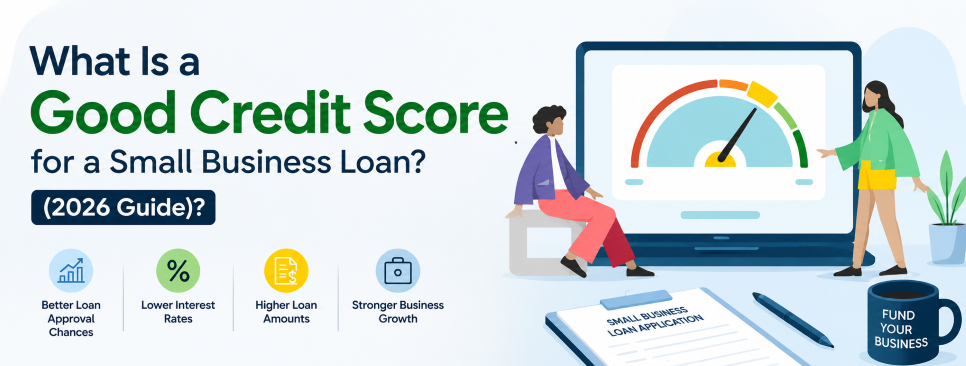
What is a good credit score for a small business loan in India? Learn the ideal CIBIL score, minimum requirements, and how to boost your approval odds.
You've found the perfect opportunity for your business. Maybe it's a bulk inventory deal, a new store location, or equipment that will double your output. There's just one problem, you need funding fast, and you're not sure if your credit score is good enough to get approved.
This is one of the most common questions small business owners in Bangalore and across India ask lenders: what is a good credit score for a small business loan?
The short answer: most banks and NBFCs in India consider 750 and above a good CIBIL score for a business loan, though some lenders approve loans with scores as low as 650–700, often with stricter terms. But the full answer is more nuanced, and understanding it can be the difference between a same-day approval and a rejected application.
In this guide, we'll break down exactly what score range you need, how lenders evaluate business loan eligibility, and practical steps to strengthen your application, even if your score isn't where it needs to be yet.
What Is a Good CIBIL Score for a Business Loan?
A CIBIL score is a three-digit number ranging from 300 to 900 that represents your creditworthiness, based on your repayment history, credit utilization, and overall debt behavior. Lenders use this score as a quick snapshot of how reliably you've handled borrowed money in the past.
For a business loan specifically, here's how Indian lenders typically categorize CIBIL scores:
| CIBIL Score Range | Category | Business Loan Outcome |
|---|---|---|
| 750–900 | Excellent | High approval chances, best interest rates |
| 700–749 | Good | Approval likely, standard to slightly higher rates |
| 650–699 | Fair | Possible approval, higher rates, more documentation |
| 550–649 | Poor | Difficult approval, may need collateral or a co-applicant |
| Below 550 | Very Poor | Approval highly unlikely from traditional lenders |
If you're wondering, "what is the minimum CIBIL score for a business loan?", most public and private sector banks set the bar at 700, while NBFCs and fintech lenders are often more flexible, sometimes approving loans for applicants with scores around 650.
Curious where your score currently stands? You can run a free credit score check in minutes before you start applying, it's the smartest first step in any loan journey.
Why Does Your Credit Score Matter So Much for Business Loans?
Unlike a shopkeeper deciding whether to extend informal credit to a regular customer, banks and NBFCs process thousands of loan applications and can't personally vet every borrower's character. Your credit score becomes their fastest, most reliable proxy for risk.
Here's why it carries so much weight:
- It predicts repayment behavior. Lenders use historical data to estimate the probability of default. A higher score statistically correlates with fewer missed payments.
- It speeds up underwriting. A strong score often means faster approvals, sometimes within 24–48 hours with digital lenders, because less manual verification is needed.
- It influences your interest rate. Borrowers with excellent scores are offered lower interest rates because they're seen as lower risk, which directly reduces your total repayment cost.
- It determines your loan amount and tenure. A good score can unlock higher loan limits and more flexible repayment periods.
If you want to understand exactly what goes into this number, our guide on what a credit score is and why it matters breaks it down in detail.
What Is the Ideal Credit Score for a Business Loan in India?
While 700+ gets your foot in the door, the ideal credit score for a business loan is genuinely 750 or above. Here's what changes once you cross that threshold:
1. Lower Interest Rates
Lenders reserve their best pricing for low-risk borrowers. A jump from 680 to 780 can shave off 1–3 percentage points on your interest rate, a meaningful saving over a 3–5 year loan tenure.
2. Higher Loan Eligibility
With a strong score, lenders are more willing to sanction higher amounts relative to your business turnover, since they're confident in your repayment discipline.
3. Minimal Documentation and Faster Turnaround
Applicants with scores above 750 often go through simplified underwriting, sometimes bypassing additional collateral requirements or guarantor conditions.
4. Negotiating Power
A high score gives you leverage to compare offers across multiple lenders and negotiate better terms, rather than accepting whatever is offered.
Business Loan Eligibility: It's Not Just About Your Score
Here's something many first-time applicants don't realize, your CIBIL score alone won't get you approved. Lenders look at a combination of factors when evaluating small business loan eligibility.
Key Factors Lenders Evaluate
- Personal and business credit score — For proprietorships and small businesses, your personal CIBIL score is usually the primary factor, since business credit history may be limited.
- Business vintage — Most lenders require the business to be operational for at least 1–3 years.
- Annual turnover and profitability — Lenders assess whether your cash flow can comfortably support EMI payments.
- Existing debt obligations — A high debt-to-income ratio, even with a good score, can hurt eligibility.
- Industry type and risk profile — Certain sectors are viewed as higher or lower risk based on market volatility.
- Bank statements and ITRs — Consistent income documentation strengthens your case significantly.
- Collateral (for secured loans) — Offering security can offset a lower credit score in many cases.
In short, credit score requirements for a business loan work alongside, not instead of, your overall financial profile. A 760 score with erratic cash flow may get rejected, while a 690 score with strong, consistent revenue might sail through.
How Lenders Check Your Credit Score for a Business Loan?
Understanding the process helps you prepare better. Here's a simplified step-by-step of what happens behind the scenes:
- Application submission — You submit your PAN, business details, and financial documents.
- Credit bureau pull — The lender pulls your CIBIL (or Experian/Equifax) report using your PAN.
- Score and report analysis — Underwriters review not just the score, but the full report — payment history, credit mix, credit utilization, and any defaults.
- Risk assessment — Your score is combined with income, turnover, and existing liabilities to calculate a risk rating.
- Decision and offer — Based on the risk category, the lender either approves with terms, requests additional documents, or rejects the application.
If you want to see exactly what lenders review in this step, check out our detailed breakdown of what shows on a credit report.
Common Myths About Credit Scores and Business Loans
There's a lot of misinformation floating around, and believing the wrong thing can cost you an approval. Let's clear up a few:
- Myth: "A 700 score guarantees approval." Reality: It improves your odds significantly, but lenders still evaluate income, turnover, and debt levels.
- Myth: "Checking my own score lowers it." Reality: Checking your own score is a soft inquiry and has zero impact on your CIBIL score.
- Myth: "New businesses can't get loans regardless of score." Reality: Many fintech lenders now offer loans to businesses under 2 years old if the owner's personal score and cash flow are strong.
- Myth: "One missed payment won't matter." Reality: Even a single default can pull your score down by 50–100 points, depending on the loan type and how recent it was.
For a fuller list, read our post on common credit score myths debunked.
What If Your Credit Score Isn't "Good" Yet?
If your score currently falls below the ideal range, don't panic, it's not the end of the road. Here's what you can realistically do.
Option 1: Improve Your Score Before Applying
If you have some time before you need the funds, focus on strengthening your score first. Small, consistent actions can meaningfully move the needle within 3–6 months. Our guide on how to improve your CIBIL score in India covers proven, actionable strategies.
Quick wins include:
- Paying all existing EMIs and credit card bills on time, every time
- Reducing credit utilization below 30% of your total limit
- Avoiding multiple loan applications within a short window
- Correcting any errors on your credit report (more common than you'd think)
- Not closing old credit accounts, since credit history length matters
Option 2: Apply with a Co-Applicant or Guarantor
Adding a co-applicant with a stronger credit profile can improve your combined eligibility and reduce perceived risk for the lender.
Option 3: Offer Collateral
Secured business loans (against property, gold, or fixed deposits) often have more flexible credit score requirements since the lender's risk is offset by the asset.
Option 4: Explore NBFCs and Fintech Lenders
Traditional banks tend to be conservative, but many NBFCs and digital lending platforms use alternative data (like GST filings, UPI transaction history, and bank statement analysis) alongside your CIBIL score, making approvals more accessible for scores in the 650–700 range.
Option 5: Build Credit From Scratch (For New Entrepreneurs)
If you're a first-time borrower with little to no credit history, you're not automatically disqualified, you just need a strategy. Our guide on building your credit score from scratch in India is written specifically for first-time applicants.
Mistakes That Silently Damage Your Business Loan Eligibility
Many applicants unknowingly sabotage their own score right before applying. Watch out for these:
- Maxing out business credit cards in the weeks before applying
- Missing even a single EMI due to cash flow mismanagement
- Applying to multiple lenders simultaneously (each hard inquiry dings your score)
- Ignoring inaccuracies on your credit report
- Co-signing loans for others without accounting for the added liability
We've covered this in more depth in our post on 10 common mistakes that lower your credit score, worth a read before you submit any loan application.
How to Check Your Credit Score Before Applying?
Before you approach any bank or NBFC, checking your score should be non-negotiable. It lets you:
- Know exactly where you stand
- Identify and dispute errors early
- Time your application strategically
- Compare lenders that match your score range
You can get a free credit score check without affecting your score at all, since self-checks are treated as soft inquiries by credit bureaus.
Real-World Example: How Score Impacts Loan Terms
Consider two Bangalore-based business owners applying for a ₹10 lakh business loan:
Owner A has a CIBIL score of 780, three years of consistent GST filings, and no missed payments. They're offered the loan at 13% interest with minimal documentation, approved within 48 hours.
Owner B has a CIBIL score of 660, a shorter business history, and one late payment from 18 months ago. They're eventually approved, but at 17% interest, with a request for collateral and a longer verification process spanning nearly two weeks.
The difference in interest alone, 4 percentage points on ₹10 lakh over 3 years, can add up to well over ₹60,000 in extra repayment. This is exactly why understanding and actively managing your credit score for a business loan isn't just a formality, it has real financial consequences.
Key Takeaways
- A CIBIL score of 750+ is considered excellent for a business loan; 700–749 is good; below 650 makes approval difficult with traditional lenders.
- Credit score is one of several eligibility factors, turnover, business vintage, and existing debt matter just as much.
- NBFCs and fintech lenders offer more flexibility than traditional banks for borrowers in the 650–700 range.
- Improving your score before applying, even by 50–100 points, can significantly reduce your interest rate and improve approval odds.
- Always check your credit score before applying, it costs nothing and tells you exactly where you stand.
FAQs: Credit Score for Business Loans
1. What is a good credit score for a small business loan in India?
A CIBIL score of 750 or above is considered excellent for a small business loan, while 700–749 is generally viewed as good and sufficient for approval by most banks and NBFCs.
2. What is the minimum CIBIL score required for a business loan?
Most traditional banks require a minimum CIBIL score of around 700, though NBFCs and fintech lenders may approve applications with scores as low as 650, depending on other eligibility factors.
3. Can I get a business loan with a low credit score?
Yes, it's possible through NBFCs, secured loans with collateral, or by adding a co-applicant with a stronger credit profile, though you may face higher interest rates and stricter terms.
4. Does checking my own credit score lower it?
No. Checking your own credit score is considered a "soft inquiry" and has no negative impact on your CIBIL score, unlike lender-initiated "hard inquiries."
5. How much does credit score affect business loan interest rates?
Credit score significantly affects interest rates, borrowers with scores above 750 often receive rates 1–4 percentage points lower than those with scores in the 650–700 range.
6. How can I improve my credit score before applying for a business loan?
Focus on timely EMI and credit card payments, keeping credit utilization below 30%, avoiding multiple loan applications at once, and correcting any errors on your credit report.
Ready to Check Where You Stand?
Your credit score is one of the biggest levers you control before applying for a small business loan, and the good news is, you don't have to guess where you stand. Whether you're preparing to apply next month or next week, knowing your score today gives you time to improve it, choose the right lender, and negotiate better terms.
Get your free credit score check and explore tailored credit card and loan options with FixRupee today. Check Your Credit Card Eligibility →