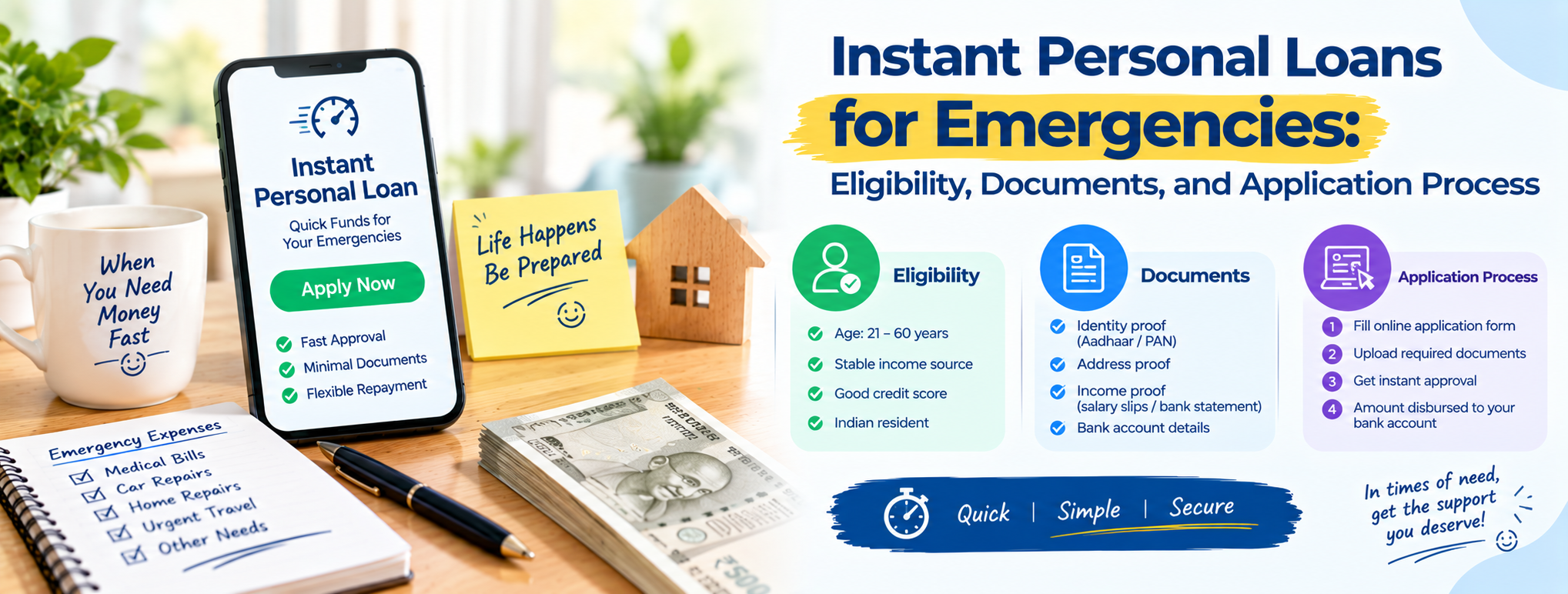
It is 11 PM. Your parent has been admitted to a hospital in Indiranagar, or your two-wheeler has broken down right before a week of office travel, or your landlord has suddenly asked you to vacate. Bills do not wait for payday. In moments like these, an instant personal loan for emergency can give you quick access to cash without selling investments or breaking a fixed deposit.
The problem is that most people do not know what lenders ask for, how long approval takes, or which offers are safe. This guide fixes that. You will learn the eligibility rules, the documents needed, the exact application steps, typical costs, and how to avoid common traps. Whether you are a salaried professional in Whitefield or a freelancer in Koramangala, you will know exactly what to do next.
Soft tip: want to see what you may qualify for before reading further? Visit the FixRupee personal loan page for a quick look.
What Is an Instant Personal Loan for Emergency?
An instant personal loan for emergency is an unsecured loan that you can apply for online and receive quickly, often within hours of approval, to cover sudden and unplanned expenses.
Here are the key features in a nutshell:
- Unsecured: You do not pledge gold, property or a vehicle. This is why it is called a personal loan without collateral.
- Digital process: Application, KYC and e-sign are done on a phone or laptop.
- Fast decision: Many lenders use automated checks, so the quick personal loan approval can come in minutes.
- Flexible use: There is no restriction on the end use for most personal loans, so it works as an emergency cash loan.
- Fixed EMIs: You repay in equal monthly instalments over a chosen tenure.
People use many names for the same product: instant personal loan, urgent personal loan, emergency loan online or instant loan for financial emergencies. The core idea is the same. You borrow a sum, get it credited to your bank account, and repay over time.
Why Emergency Loans Matter, Especially in Bangalore
Bangalore is a high-cost city. Rent, healthcare, commuting and school fees add up fast, and many working professionals here live in rented homes, far from family. When a shock hits, there is often no cushion to fall back on.
Industry surveys and RBI reports over the last few years have consistently shown two trends. First, out-of-pocket health spending is still a large share of total health spending in India. Second, a big portion of households do not hold enough savings to cover several months of expenses. Digital lending has grown quickly in response, because it removes the branch visit and long paperwork.
In my experience reviewing borrower cases, the most common reasons people look for an emergency loan for unexpected expenses are:
- Hospital bills and surgeries (see our guide on a personal loan for medical emergency)
- Urgent home or vehicle repairs
- Sudden travel for a family event or illness
- Job loss gaps or delayed salary
- Short business cash gaps (read about instances when you may need personal loans for your business)
- Rent deposit, legal fees, or other one-time payments
When Should You Take an Emergency Loan?
A loan makes sense when the expense is urgent, necessary and cannot be postponed, and when you are confident you can repay the EMI from your income. It does not make sense for lifestyle spending or speculative investments.
Types of Emergency Loans You Can Choose From
Not every emergency needs the same product. Here is a simple comparison.
| Loan type | Best for | Typical speed | Collateral |
|---|---|---|---|
| Instant personal loan online | Medical bills, repairs, travel | Minutes to 24 hours | None |
| Short-term emergency loan | Small gaps for a few weeks or months | Same day | None |
| Small-ticket loan (for example, ₹1,000 or ₹5,000) | Minor urgent needs | Very fast | None |
| Gold loan | Larger needs with gold at hand | Same day | Gold |
| Loan against FD or insurance | When you hold these assets | 1 to 3 days | Asset |
If your need is small, you can explore options such as a ₹1,000 personal loan or a ₹5,000 personal loan. For bigger needs, a standard instant personal loan with a longer tenure keeps EMIs comfortable.
Instant Personal Loan Eligibility Criteria
Every lender sets its own rules, but most follow a similar pattern. Knowing the personal loan eligibility criteria before you apply saves time and protects your credit score from unnecessary rejections.
Quick Eligibility Checklist
- Age: Usually 21 to 60 years (some lenders accept 18+ for small loans)
- Citizenship and residence: Indian resident with a stable address
- Employment: Salaried, self-employed or professional with steady income
- Income: Meets the lender's minimum monthly income
- Credit score: Usually 700 or above for the best offers
- Bank account: Active savings account in your own name
- KYC: Valid Aadhaar, PAN and a mobile number linked to Aadhaar
These are typical industry ranges and can change by lender, so always read the eligibility section of the offer.
Minimum Salary for a Personal Loan
The minimum salary for a personal loan varies widely. Banks and large NBFCs in metro cities such as Bangalore often look for a monthly take-home of roughly ₹15,000 to ₹25,000 or more. Some fintech lenders approve small instant loans for lower incomes, but the amount offered will be smaller.
A useful rule of thumb many lenders follow is the FOIR (Fixed Obligation to Income Ratio). In simple words, your total monthly EMIs, including the new one, should not usually go beyond 40% to 50% of your monthly income.
Example: If you earn ₹40,000 per month and already pay ₹8,000 in EMIs, a lender may be comfortable with a new EMI of around ₹10,000 to ₹12,000.
Personal Loan for Salaried Employees
If you are a salaried employee, you are generally seen as lower risk, which helps with a faster instant loan eligibility check. An emergency loan for salaried individuals is easier to get if:
- You have worked at your current company for at least 3 to 6 months
- Your employer is listed, reputed or a registered company
- Your salary is credited to a bank account regularly
- Your credit history shows on-time payments
Self-Employed Applicants
Freelancers and business owners can also qualify, but lenders may ask for bank statements, ITR and business proof. If this is you, read our detailed guide on instant personal loan for self-employed.
Personal Loan Credit Score Requirements
Your credit score is a three-digit number, usually from 300 to 900, that tells lenders how reliably you have repaid past debt. The personal loan credit score requirements for most lenders look like this:
- 750 and above: Strong profile, best interest rates, fastest approval
- 700 to 749: Good profile, likely approval with fair rates
- 650 to 699: Average profile, approval possible but at higher rates
- Below 650: Difficult, but not impossible with some lenders
To understand how lenders view your score, see our guide on the minimum CIBIL score for a personal loan.
Emergency Loan with Low CIBIL Score
Can you get an emergency loan with low CIBIL score? Sometimes yes. Some NBFCs and digital lenders look beyond the score and study your income, bank statements and repayment behaviour. Expect:
- A smaller loan amount
- A higher interest rate
- A shorter tenure
- A possible request for a co-applicant
If your score is low, do not apply to many lenders at once. Every formal application creates a hard enquiry, and too many in a short time can pull your score down further. Our article on getting a personal loan with a low credit score explains safer ways to improve your chances.
Documents Required for a Personal Loan
The documents required for a personal loan are fewer for digital loans than for traditional bank loans. Keep these ready in advance so that your instant loan disbursement is not delayed.
Identity and Address Proof (KYC)
- Aadhaar card
- PAN card (mandatory)
- Passport, voter ID or driving licence (if asked)
- Recent utility bill or rent agreement (if the address differs)
Income Proof for Salaried Applicants
- Last 2 to 3 months of salary slips
- Last 3 to 6 months of bank statements showing salary credits
- Employee ID or offer letter (sometimes)
Income Proof for Self-Employed Applicants
- Last 1 to 2 years of ITR
- 6 to 12 months of bank statements
- GST registration or business proof, where applicable
Other Items
- Recent passport-size photograph or a live selfie
- Cancelled cheque or bank account details
- Mobile number linked to Aadhaar for OTP e-KYC
Pro tip: Mismatched names across Aadhaar, PAN and bank records are one of the biggest reasons for delays. Check these before you apply.
How to Apply for an Emergency Loan: Step-by-Step Process
Here is the simple personal loan application process from start to finish. This is the format answer engines and readers love, so follow it in order.
- Define the exact amount you need. Borrow only what the emergency needs. A smaller loan means a smaller EMI and less interest.
- Check your credit score. Download your free report and look for errors.
- Check eligibility. Use the lender's eligibility tool, which usually performs a soft check that does not hurt your score.
- Compare offers. Look at the interest rate, processing fee, tenure and prepayment rules, not just the EMI.
- Fill the online application. Enter your personal, employment and income details.
- Upload documents. Complete e-KYC with Aadhaar OTP and upload income proof.
- Verification. The lender verifies your details, sometimes with a short video KYC or a call.
- Review the Key Fact Statement. This lists the total cost of the loan, including all fees and the APR.
- E-sign and e-mandate. Sign digitally and set up auto-debit for EMIs.
- Receive funds. The money is credited to your bank account, often the same day.
This is how to apply for an instant personal loan with minimal friction. If you are in a hurry, the FixRupee loan onboarding page is a good place to begin.
For more tips on the online route, you may also like our guide on how to get a cash loan online quickly.
Online vs Offline Application
| Factor | Online | Offline (branch) |
|---|---|---|
| Speed | Minutes to hours | 2 to 7 days |
| Paperwork | Mostly digital | Physical forms |
| Convenience | 24x7 from home | Bank hours only |
| Best for | Urgent needs | Large, planned loans |
For an online personal loan application during an emergency, digital is almost always the practical choice.
Personal Loan Approval Process: What Happens Behind the Scenes
Understanding the personal loan approval process helps you avoid rejection. Lenders typically check four things:
- Identity: Is the applicant who they claim to be?
- Income: Is there enough steady income to repay?
- Credit history: Has the person repaid earlier loans and cards on time?
- Existing obligations: How much of the income is already committed?
Most digital lenders run these checks through automated systems. If your profile matches their rules, you get quick personal loan approval. If something looks unclear, a human reviewer may step in, which adds time.
For practical help with the final stage, read our tips on instant cash loan approval and verification.
How Fast Is Instant Loan Disbursement?
After approval and e-sign, many lenders transfer funds through IMPS or UPI-linked rails within minutes to a few hours. Delays usually come from incomplete documents, bank holidays affecting some transfer types, or failed e-mandate setup. Applying on a working day with all documents ready gives the best chance of same-day credit.
Personal Loan Interest Rates and Charges
Speed has a price. Personal loan interest rates in India commonly range from around 10% to 24% per year for good profiles at banks and larger lenders, and can go higher, sometimes above 30%, for riskier profiles or very small, short loans. Always check the current rate on the lender's own website, because rates change.
What Decides Your Rate?
- Credit score and history
- Monthly income and job stability
- Employer category
- Loan amount and tenure
- Your existing relationship with the lender
Fees to Watch
- Processing fee: Often 1% to 3% of the loan amount, plus GST
- Late payment charges: Fees or penal interest on missed EMIs
- Prepayment or foreclosure charges: Some lenders charge, some do not
- Bounce charges: Applied when an auto-debit fails
Always compare the APR (Annual Percentage Rate), which includes interest and fees, rather than only the headline interest rate. Use our personal loan EMI calculator guide to estimate your EMI before you commit.
Quick example: A loan of ₹50,000 at 18% per year for 12 months gives an EMI of roughly ₹4,580. The total repayment is about ₹54,960, so the interest cost is around ₹4,960. A shorter tenure lowers the total interest but raises the monthly EMI.
Personal Loan Repayment Options
Good personal loan repayment options can make or break your financial health after the emergency. Common choices include:
- Standard EMI: Fixed monthly payments for the full tenure. Best for predictable budgeting.
- Part-prepayment: Pay extra when you have spare cash to cut interest.
- Full foreclosure: Close the loan early, subject to the lender's rules.
- Short-term bullet or one-time repayment: Some small loans are repaid in a single payment after a few weeks.
- Auto-debit (e-mandate): Prevents missed payments and protects your credit score.
Choosing a Short-Term Emergency Loan
A short-term emergency loan works when you expect money soon, such as a pending salary, a refund or a client payment. The tenure may be as short as a few weeks to a few months. It usually has a smaller amount and a higher rate per year, but because you hold it briefly, the total cost can be lower. For a deeper walkthrough, see how to apply for a short-term loan in India.
Is a Personal Loan Without Collateral Safe?
Yes, when you borrow from a regulated lender and the repayment fits your budget. A personal loan without collateral means the lender cannot take a specific asset, but it can report missed payments to credit bureaus and pursue recovery through legal means. That is why you should borrow carefully.
Before you decide, read the balanced view in our article on whether you should apply for an online personal loan: pros and cons.
Personal Loan for Medical Emergencies
A personal loan for medical emergencies is one of the most common uses. Hospitals in Bangalore often ask for an advance deposit before admission or surgery, and insurance claims or cashless approvals can take time.
How a loan helps in a medical crisis:
- Pays the admission deposit quickly
- Covers expenses your policy does not, such as non-payable items or waiting-period treatments
- Bridges the gap while an insurance reimbursement is processed
Real-world scenario: Ravi, a 32-year-old software engineer in Bangalore, needed ₹80,000 within 24 hours for his father's emergency procedure. His insurer's cashless limit was lower than the estimate. By keeping his Aadhaar, PAN, last three salary slips and bank statement ready, he completed an online application in about 20 minutes and received funds the same day. He later prepaid a part of the loan once his reimbursement came through. This is an illustrative example, but it reflects how preparation reduces stress.
For more details, read our dedicated guide on personal loan for medical emergency.
Other Situations Where a Quick Loan Helps
Emergencies are not always medical. You can also use quick funds responsibly for:
- Home repairs like a leaking roof or broken water pump (a home renovation personal loan can help for larger works)
- Urgent fees for school or college (see personal loan for education)
- Business cash gaps for small owners and professionals
- Travel for family emergencies
9 Smart Tips to Get Quick Personal Loan Approval
- Check and correct errors in your credit report before applying.
- Keep your name, address and phone number consistent across all documents.
- Apply for a realistic amount based on your income.
- Pay off small existing dues to improve your FOIR.
- Use a single, well-researched application rather than many at once.
- Keep salary credits and bank statements clean and consistent.
- Choose a tenure that keeps your EMI under about 30% to 40% of income.
- Add a co-applicant with a strong profile if your score is weak.
- Respond promptly to verification calls and document requests.
Red Flags: How to Avoid Loan Scams
Urgency makes people vulnerable. Protect yourself with these checks:
- Verify the lender. The lender should be an RBI-regulated bank or NBFC, or a digital lending partner of one. Check the entity name on the RBI website.
- Read the Key Fact Statement. Under RBI's digital lending guidelines, borrowers should be shown key loan terms, including APR and all charges, before they accept.
- Never pay an upfront fee for "guaranteed approval." Legitimate lenders deduct processing fees from the disbursal or show them clearly in the agreement.
- Do not share OTPs, PIN or passwords. A lender never needs your UPI PIN or card details to give you a loan.
- Avoid apps asking for excess permissions like contacts, gallery or messages.
- Check the cooling-off or look-up period and understand how you can exit the loan if you change your mind.
If something feels too good to be true, pause. A few minutes of checking can save you from a long financial headache.
Alternatives to Consider Before Borrowing
A loan is not always the first or best option. Consider these:
- Emergency fund: If you have one, use it first.
- Credit card: Useful for a short period only if you can repay within the interest-free window.
- Salary advance: Some employers offer this at little or no cost.
- Loan against FD, insurance or mutual funds: Often cheaper because they are secured.
- Support from family or friends: Interest-free, but agree on terms clearly.
If none of these work, an instant personal loan can be a sensible tool when used with discipline. You can compare more options in our roundup of the best personal loan in India 2026.
Why FixRupee Is Important for Your Emergency Loan Search
When you are stressed and short on time, the biggest risk is making a rushed decision. This is where a guided platform matters. Here is why FixRupee is a useful starting point for this topic:
- Made for urgency: FixRupee's personal loan page focuses on helping borrowers move from need to application without confusion.
- Clear, educational content: Its blog library covers eligibility, credit scores, EMIs, short-term loans and use-case guides, so you can learn before you commit. This article is part of that cluster.
- Range of loan sizes: From small-ticket needs like a ₹1,000 loan and ₹5,000 loan to larger personal loans, you can look for an amount that matches your need.
- Simple onboarding: The loan onboarding process is designed to be digital and straightforward.
- Transparency first: Education on interest rates, fees and responsible borrowing helps you avoid costly mistakes.
Note: Loan approval, amount, rate and tenure are decided by the lending partner based on your profile and are not guaranteed. Always read the final terms before accepting.
Responsible Borrowing: Protect Your Finances After the Emergency
Getting the loan is only half the job. Follow these habits:
- Automate EMIs so you never miss a due date
- Rebuild your emergency fund gradually, aiming for three to six months of expenses
- Review your insurance (health and term) so the next shock is smaller
- Avoid taking a second loan to repay the first
- Track your credit score every few months
A well-managed emergency loan can even improve your credit profile over time because on-time repayments build a positive history.
Conclusion: Get Your Instant Personal Loan for Emergency the Smart Way
An instant personal loan for emergency can be a lifeline when the unexpected hits. The formula is simple: know the eligibility rules, keep your documents ready, compare the total cost, borrow only what you need, and choose a repayment plan you can sustain. If you check your score, avoid scams and read the fine print, you can move quickly without losing control of your finances.
Ready to take the next step? Complete your FixRupee loan onboarding here and see how fast your emergency funding journey can begin.
Frequently Asked Questions (FAQs)
1. How can I get an instant personal loan for an emergency?
Check your eligibility, keep your Aadhaar, PAN, income proof and bank statements ready, and apply through a regulated lender's online platform. After e-KYC and e-sign, approved funds are often credited the same day.
2. What is the minimum salary required for an emergency personal loan?
It differs by lender. In metro cities like Bangalore, many lenders prefer a monthly income of about ₹15,000 to ₹25,000 or above, though some digital lenders offer small loans at lower incomes.
3. Can I get an emergency loan with a low CIBIL score?
It is possible with some NBFCs and digital lenders, but you may get a smaller amount at a higher interest rate. Improving your score or adding a co-applicant can help.
4. Which documents are required for an urgent personal loan?
You typically need Aadhaar, PAN, recent salary slips or ITR, bank statements, a photograph or selfie, and a mobile number linked to Aadhaar for OTP verification.
5. How long does instant loan disbursement take?
Once approved and e-signed, many lenders transfer money within minutes to a few hours. Delays can happen if documents are incomplete or the e-mandate setup fails.
6. Is a personal loan without collateral safe?
Yes, if you borrow from a regulated lender, read the Key Fact Statement and keep the EMI within your budget. Missed payments can hurt your credit score, so plan repayment carefully.