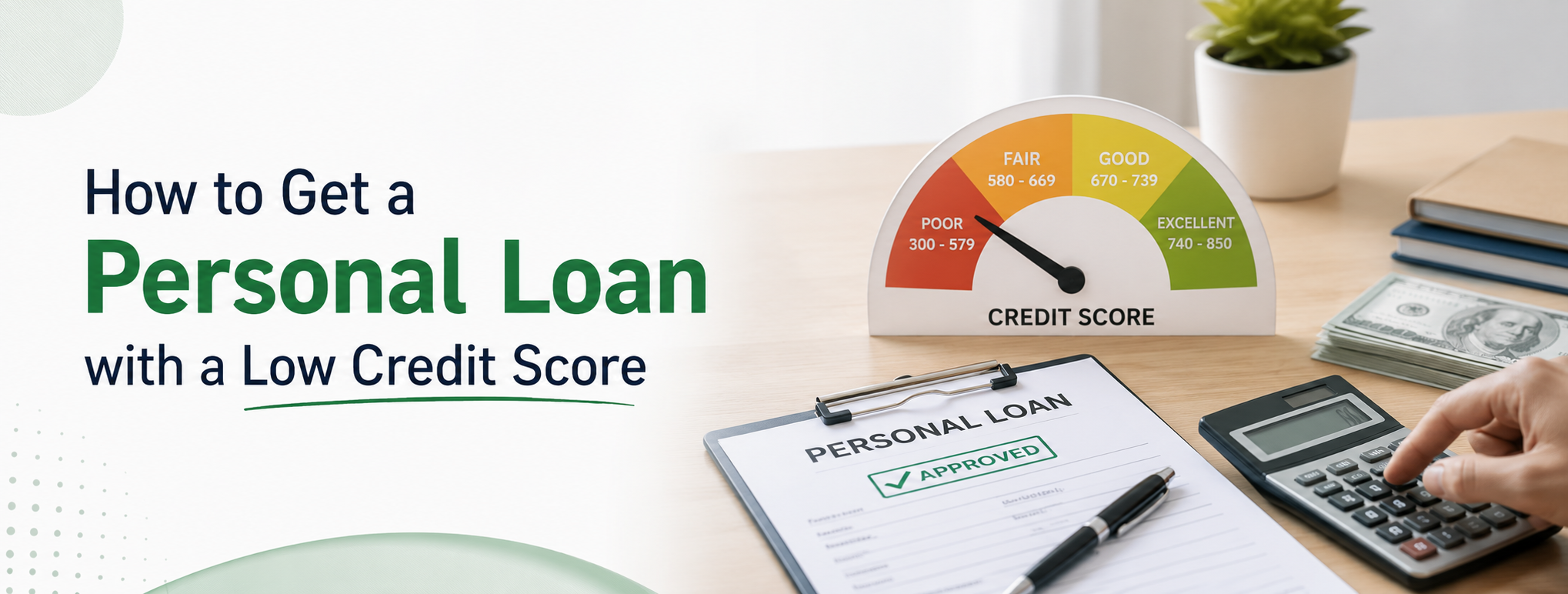
How to Get a Personal Loan with a Low Credit Score
A low credit score doesn't have to mean the end of your loan application. While a poor CIBIL score does make traditional banks cautious, several NBFCs and digital lenders — including FixRupee — evaluate far more than just your three-digit score before approving a personal loan. This guide walks you through exactly how to get a personal loan with low credit score, what a loan for bad CIBIL score realistically requires, whether a personal loan without credit history is even possible, and which low CIBIL score loan apps are worth comparing in 2026.
What Counts as a "Low" CIBIL Score?
A CIBIL score below 650 is generally considered low, and anything under 600 is classified as poor by most lenders.
Your CIBIL score is a three-digit number between 300 and 900, generated by TransUnion CIBIL based on your repayment history, credit utilisation, credit mix, and length of credit history. A higher number signals responsible credit behaviour; a lower one usually points to missed EMIs, high credit card usage, or frequent loan applications in a short period. Here's how lenders typically bucket it:
| CIBIL Score Range | Category | Loan Approval Odds |
|---|---|---|
| 750–900 | Excellent | High — best interest rates |
| 700–749 | Good | High approval, standard rates |
| 650–699 | Fair | Moderate — may need income proof |
| 600–649 | Low | Limited to NBFCs/fintech lenders |
| Below 600 | Poor | Difficult but not impossible |
| No score / NA-NH | New-to-credit | Requires alternate assessment |
A low cibil score loan isn't rejected automatically — but it does change which lenders will consider you, how much they'll lend you, and what they'll charge for it.
Why Do Lenders Hesitate on Low-Score Applications?
Lenders see a low CIBIL score as a signal of higher default risk, which is why they either reject the application, ask for collateral, or charge a higher interest rate.
Understanding the lender's side of the equation helps you present a stronger application. A few specific red flags drive the hesitation:
- Past repayment behaviour. A low score usually reflects missed or delayed EMIs. Lenders reasonably worry this pattern could repeat.
- High credit utilisation. Regularly maxing out credit cards signals dependence on credit for everyday expenses, which raises concern about your ability to absorb a new EMI.
- Multiple recent enquiries. Applying to several lenders in a short window makes you look "credit hungry" and can itself pull your score down further.
- The unsecured nature of personal loans. Since there's no collateral backing the loan, the lender has no asset to recover if you default — so score and income become the only risk signals they have.
None of this means an outright "no." It simply means you need to compensate with stronger proof of current repayment capacity — which is exactly what the next few sections cover.
Can You Really Get a Personal Loan with Bad Credit?
Yes. Getting a personal loan for a low CIBIL score is possible if you can show stable income, apply through the right type of lender, and ask for a realistic loan amount.
Traditional banks rely almost entirely on your credit score to approve applications, which is why they reject most low-score applicants outright — many banks set an internal cutoff around 700–730. NBFCs and digital lending apps, on the other hand, use a broader risk model that factors in your monthly income, employment stability, bank statement patterns, and increasingly alternate data like UPI transaction history. This is exactly why fintech lenders have become the realistic route for a personal loan with low credit score in India today.
That said, go in with the right expectations. Compared to a borrower with a 750+ score, someone with a low score should expect:
- Higher interest rates, to compensate the lender for added risk
- Smaller sanctioned loan amounts than requested
- Shorter or more flexible repayment tenures
- Occasionally, a request for a co-applicant, guarantor, or minor collateral
These trade-offs are the cost of accessing credit now — and repaying responsibly is the fastest way to remove them on your next loan.
Step-by-Step: How to Get a Personal Loan with a Low CIBIL Score
Follow these steps in order to maximise your approval chances even with a poor credit score.
1. Check your CIBIL report for errors first
Before assuming your score is accurate, pull your credit report and go through it line by line — a closed loan showing as "active," a settled dues marked "unpaid," or someone else's default wrongly linked to your PAN are more common than people expect. Raising a dispute with the bureau can correct your score within a few weeks, sometimes enough to move you into a better approval bracket.
2. Choose an NBFC or digital lender, not a traditional bank
Banks typically cut off applications below a 700–750 score without much room for negotiation. NBFCs and instant loan apps evaluate income and repayment capacity more holistically, making them the realistic route for a loan for bad cibil score. Start your search here rather than wasting hard inquiries on banks likely to reject you.
3. Apply for a smaller loan amount
A modest ask, sized to your income, is far easier to get approved than a large one — it keeps your EMI-to-income ratio comfortable, which is one of the first things underwriters check. Smaller loans are also easier to repay on schedule, which helps rebuild your score for future, larger borrowing needs.
4. Add a co-applicant or guarantor with a good score
If a spouse, parent, or sibling has a healthy credit history and stable income, applying jointly can meaningfully change the outcome — the lender assesses both profiles together, and a strong co-applicant can offset your weaker score. Keep in mind the co-applicant becomes equally responsible for repayment.
5. Show proof of stable income
Recent salary slips, 3–6 months of bank statements, and ITRs (for self-employed applicants) reassure lenders that your current cash flow can service the EMI regardless of what your credit history shows. A steady, verifiable income is often the single strongest counterweight to a low score.
6. Reduce existing debt before applying
Lenders look closely at your debt-to-income ratio. If you're already juggling multiple EMIs or high credit card balances, paying some of that down first — even partially — improves both your score and your approval odds.
7. Be prepared for a higher interest rate
Lenders price in the added risk of lending to a low-score borrower. Accepting a slightly higher rate now and repaying on time is often the fastest, most practical way to qualify for better rates on your next loan.
Personal Loan Without Credit History — Is It Possible?
Yes, first-time borrowers with no CIBIL score can still qualify for a personal loan without credit history by relying on income documentation, salary account relationships, or alternate data-based lending apps.
Having no credit history (a "NA" or "NH" CIBIL status) is different from having a bad one — lenders simply can't assess risk based on past behaviour that doesn't exist yet, so they lean on other signals instead:
- Salary account and banking relationship. If your salary is credited to the lender's own bank, they already have visibility into your income consistency, which substitutes for a credit history.
- Employer category. Applicants working at MNCs, PSUs, or listed companies are often viewed as lower-risk, since stable employers imply stable income.
- Consistent monthly income above the lender's minimum threshold. This is usually the single biggest factor for new-to-credit approvals.
- Alternate credit data. A growing number of digital lending apps now factor in UPI transaction patterns, utility bill payments, and recharge history to build a risk profile even without bureau data.
New-to-credit applicants, recent graduates, first-time earners, homemakers re-entering the workforce — are one of the fastest-growing segments for personal loans without credit history, and several digital lenders have built underwriting models specifically to serve them rather than rejecting them by default.
Best Low CIBIL Score Loan Apps to Check in 2026
Low CIBIL score loan apps use alternate data — income, spending patterns, and digital footprint — instead of relying solely on your credit score, which is why approval is often faster for low-score or no-score borrowers.
When comparing low cibil score loan apps, evaluate them on these criteria before you apply:
| What to check | Why it matters |
|---|---|
| Turnaround time | Instant vs. 24–48 hour disbursal affects how quickly you get funds |
| Interest rate transparency | Look for reducing-balance rates displayed upfront, not buried in fine print |
| Minimum income requirement | Some apps accept salaries as low as ₹15,000–₹20,000/month |
| Loan amount range | Smaller ticket sizes (₹10,000–₹5,00,000) are typical for low-score approvals |
| RBI-registered NBFC backing | A non-negotiable check — confirms the lender is regulated |
| Data privacy practices | Review what data the app accesses and how it's used before granting permissions |
FixRupee's personal loan app is built specifically for this segment — evaluating income and repayment capacity alongside your credit score, rather than rejecting applications on score alone. Whatever the loan is for, from a wedding to a medical emergency, a well-matched low-score-friendly app can get you approved faster than a repeated round of bank applications.
Documents Required for a Personal Loan with a Low CIBIL Score
Digital-first lenders typically accept scanned or photographed copies uploaded directly through the app, so no branch visit is needed.
| Document Type | Examples |
|---|---|
| Identity proof | Aadhaar, PAN card |
| Address proof | Aadhaar, utility bill, rent agreement |
| Income proof | Salary slips (last 3 months), Form 16 |
| Bank statements | Last 3–6 months |
| Photograph | Recent passport-size photo |
| Employment proof | Offer letter / employment certificate (salaried); GST/business registration (self-employed) |
| Credit report (occasionally requested) | Recent CIBIL report copy, if the lender doesn't pull it directly |
Challenges You May Still Face
Even after following every step above, expect some friction — rejection risk, higher rates, lower sanctioned amounts, and longer processing time are common realities of borrowing with a low score.
Going in prepared for these possibilities helps you plan rather than be caught off guard:
- Outright rejection is still possible. Even a strong income doesn't guarantee approval every time — some lenders have hard score cutoffs regardless of other factors.
- Higher interest rates. This is the most common trade-off, and it directly increases your total repayment cost.
- Lower loan amount than requested. Lenders often sanction less than you apply for, to limit their exposure.
- Collateral or guarantor requests. Some lenders may ask you to pledge an asset or add a guarantor even for a nominally "unsecured" loan.
- Longer processing time. Additional background checks and income verification can slow down disbursal compared to a standard application.
None of these are reasons to avoid applying — they're simply what to budget for, both financially and in terms of patience.
How to Improve Your CIBIL Score Before Applying
Paying EMIs and credit card bills on time, keeping credit utilisation under 30%, and avoiding multiple loan applications in a short span are the fastest ways to improve a low CIBIL score.
If your need isn't urgent, spending 3–6 months on the following can meaningfully raise your score and unlock better interest rates on your eventual application:
- Clear overdue EMIs or credit card dues immediately — even partial payments demonstrate intent and reduce your outstanding risk profile.
- Keep credit card usage below 30% of your total limit — high utilisation is one of the most heavily weighted factors in your score.
- Avoid applying to multiple lenders within a short window — each hard inquiry has a small negative impact, and several in a row compound that damage.
- Don't close old credit cards; a longer average credit history supports your score, even on cards you barely use.
- Set up auto-debit for EMIs and bills — missed payments are the single biggest score-killer, and automation removes the risk of forgetting.
- Monitor your score monthly. Most banks and lending apps now offer a free CIBIL score check, letting you catch problems early instead of discovering them at loan application time.
Use FixRupee's minimum CIBIL score guide for a deeper breakdown of exactly what score you need for different loan types and amounts.
Repaying Your Loan Responsibly
Once approved, disciplined repayment is what actually rebuilds your credit score and improves your terms on future loans.
Getting the loan is only half the goal — how you repay it determines whether your next application is easier or harder:
- Set EMIs on auto-debit so payments never slip due to forgetfulness.
- Keep your total EMI outgo, including this new loan, within 30–40% of your monthly income to avoid financial strain.
- Communicate early if you anticipate a missed payment — most lenders would rather restructure than report a default.
- Avoid taking on new credit immediately after this loan until your finances stabilise and your score reflects the improvement.
- Consider prepaying when you have surplus funds — it reduces your total interest outgo and reflects well in your credit history.
Six to twelve months of on-time repayment on even a small loan can visibly shift your score into a better bracket, opening the door to larger loans at meaningfully lower rates.
Loans for Every Need
Select the loan that best suits your financial requirements:
FAQs
What is the minimum CIBIL score for a personal loan?
Most banks prefer a score of 700+, but NBFCs and digital lenders often approve personal loans with a CIBIL score as low as 600, provided your income and repayment capacity are strong.
Can I get a personal loan with a CIBIL score of 550?
It's difficult through traditional banks but possible through select NBFCs and fintech lenders if you show stable income, apply for a smaller amount, or add a co-applicant with a better score.
Do low CIBIL score loan apps charge higher interest rates?
Yes. Interest rates for low-score borrowers are typically higher to offset the lender's risk. Rates tend to reduce over time as you build a positive repayment history with the same lender.
Can I get a personal loan without any credit history?
Yes — this is common for first-time borrowers. Lenders assess your income, employment stability, and sometimes alternate data like UPI transactions instead of a credit score.
Will applying for a personal loan lower my CIBIL score further?
A single application triggers a "hard inquiry," which has a small, temporary impact. Multiple applications within a short period, however, can noticeably hurt your score, so space out your applications.
How can I check my CIBIL score for free before applying?
You can check your score through the official CIBIL website, RBI-regulated lending apps, or your bank's mobile app — most now offer a free monthly score check.
How long does it take to improve a low CIBIL score?
With consistent financial discipline — on-time EMIs, low credit utilisation, no new loan applications — most people see a noticeable improvement within 4 to 12 months.
Does taking a loan with a low CIBIL score damage my credit further?
No. Taking a new loan doesn't hurt your score on its own. In fact, repaying it responsibly and on time is one of the most effective ways to improve your score over the following months.
Ready to Apply?
Don't let a low credit score stop you from getting the funds you need. Apply for a personal loan with FixRupee and get a decision based on your complete financial picture — not just your CIBIL score.