It's 11 p.m., the nearest bank is closed, and you need cash right now. You remember your credit card has an ATM option. One swipe, and the cash is in your hand.
But here's what most people don't realise at that moment: a credit card cash withdrawal isn't like a debit card withdrawal. It's a short-term loan, one of the most expensive forms of credit you can take. Interest starts from day one, fees eat into the amount you withdraw, and the "convenience" can quietly turn into a debt trap if you're not careful.
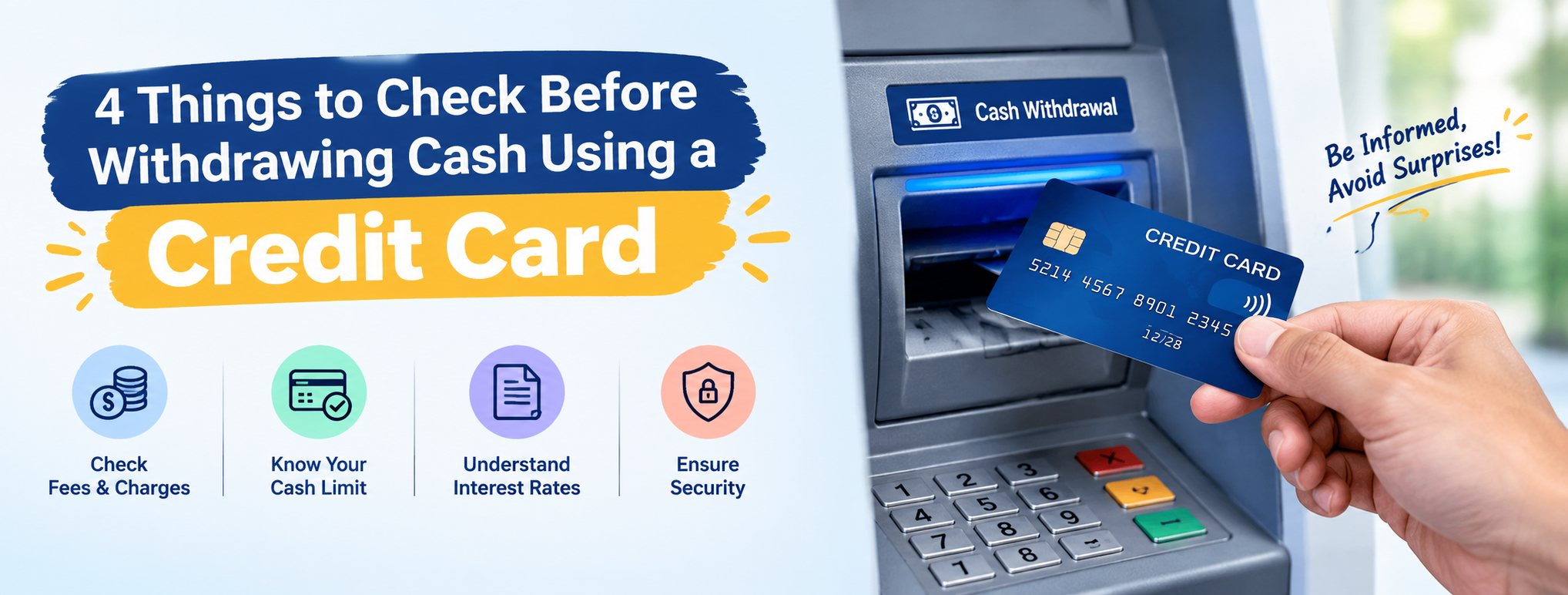
Before you walk up to that ATM, there are four things you absolutely need to check. This guide breaks each one down, with real numbers, practical examples, and a clear process you can follow, so you withdraw cash smartly, not blindly.
What Is a Credit Card Cash Withdrawal?
A credit card cash advance is the facility that lets you withdraw physical cash against your credit card's credit limit, usually at an ATM. Unlike a regular card purchase, where you often get an interest-free period of 20–50 days, a cash withdrawal from credit card attracts interest from the very first day, along with a separate withdrawal fee.
Read More: personal loan vs credit card
In simple terms: your bank treats it as an instant, unsecured loan with a high interest rate and no grace period. That's the single biggest difference people miss, and it's why understanding the fine print matters more here than with any other card feature.
1. Credit Card Cash Withdrawal Charges and Fees
The first thing to check is the fee structure, because it applies the moment you withdraw, regardless of when you repay.
Cash Advance Fee
Most Indian banks charge a flat credit card cash advance fee of 2.5% to 3.5% of the withdrawal amount, subject to a minimum (commonly ₹250–₹500). So if you withdraw ₹10,000, you could lose ₹250–₹350 instantly, before any interest is even calculated.
ATM Operator Charges
On top of the bank's fee, some ATMs (especially those not owned by your card issuer) add their own credit card ATM withdrawal charges. This is separate from the cash advance fee and often overlooked.
A Quick Example
| Withdrawal Amount | Cash Advance Fee (3%) | ATM Charge (approx.) | Day-1 Cost |
|---|---|---|---|
| ₹5,000 | ₹150 | ₹25–50 | ₹175–200 |
| ₹20,000 | ₹600 | ₹25–50 | ₹625–650 |
| ₹50,000 | ₹1,500 | ₹25–50 | ₹1,525–1,550 |
This is before a single day of interest has accrued. That's the real credit card cash withdrawal cost, and it's why financial advisors consistently flag this feature as last-resort-only.
Soft tip: If you're repeatedly short on cash, it's worth comparing this against a personal loan from FixRupee, where the cost is transparent upfront instead of layered in fees.
2. Credit Card Cash Withdrawal Interest Rate
This is where most people get caught off guard. The credit card cash withdrawal interest rate is usually the same as (or higher than) your card's regular purchase APR, typically 2.5% to 3.5% per month, which works out to 30%–42% per annum.
Read More: https://fixrupee.com/blog/credit-score-myths-debunked/
Why There's No Grace Period
With a regular purchase, you get an interest-free window until your bill due date. With a cash advance on credit card, interest is calculated from the day of withdrawal, not from the billing date. Even if you repay in full on your next due date, you'll still owe interest for every day the cash was outstanding.
How the Math Works
Let's say you withdraw ₹20,000 on the 5th of the month, and your bill is due on the 25th, a 20-day gap.
- Interest rate: 3% per month → roughly 0.0986% per day
- Interest for 20 days: ₹20,000 × 0.0986% × 20 ≈ ₹394
That ₹394 is on top of the ₹600 cash advance fee from the earlier example. Total cost for borrowing ₹20,000 for 20 days: nearly ₹1,000, an effective cost far higher than almost any formal loan product in the market.
This is the single most important number to check before withdrawing, not just the fee, but the daily interest clock that starts ticking immediately.
3. Credit Card Cash Withdrawal Limit
Not all of your credit limit is available for cash. Banks set a separate, smaller credit card cash limit, usually 20% to 40% of your total credit limit.
Read More: https://fixrupee.com/blog/what-shows-on-your-credit-report/
Example
If your total credit limit is ₹1,00,000, your usable cash limit might only be ₹20,000–₹40,000, even though your card statement shows the full ₹1,00,000 as "available credit."
How to Check Your Own Limit
- Log into your bank's mobile app or net banking.
- Go to the credit card section and look for "cash withdrawal limit" or "cash limit."
- If it isn't visible, call customer care or check your welcome kit/latest statement, it's usually printed there.
- Some banks also let you check this via SMS or missed-call banking.
Read More: https://fixrupee.com/blog/what-is-a-credit-score-role-and-importance/
Knowing your actual credit card cash withdrawal limit in advance avoids the embarrassment (and the declined-transaction fee) of trying to withdraw more than your card allows.
4. Credit Card Cash Withdrawal Rules, Eligibility and Repayment
Eligibility
Almost every active credit card comes with cash withdrawal enabled by default, but credit card cash withdrawal eligibility can vary:
- Some co-branded or entry-level cards disable the feature entirely.
- New cardholders (first 3–6 months) sometimes have a lower or zero cash limit until the bank reviews usage.
- A low credit score or irregular repayment history can reduce your eligible cash limit, even if your overall credit limit is high.
Read More: https://fixrupee.com/blog/can-we-apply-for-credit-card-and-loan-at-the-same-time/
The Repayment Trap
This is where the real risk lies. A credit card cash withdrawal penalty situation usually starts like this:
- You withdraw cash for an emergency.
- Your bill arrives, showing the withdrawal plus fees and interest.
- You pay only the "minimum amount due" instead of the full amount.
- The remaining balance rolls over, and now interest compounds on the entire outstanding balance, including your regular purchases, not just the cash advance.
This is one of the fastest ways Indian consumers fall into credit card debt. The Reserve Bank of India has repeatedly flagged minimum-due payments and cash advances as high-risk behaviours that trap consumers in revolving debt cycles.
Credit Card Cash Withdrawal Process (Step-by-Step)
- Check your cash limit via app, net banking, or customer care.
- Generate or confirm your card's ATM PIN (different from your online transaction OTP).
- Insert your credit card at any ATM and select "Credit Card" or "Cash Advance" from the menu.
- Enter the PIN and amount — stay within your available cash limit.
- Collect your cash and the receipt — keep it to cross-check against your next statement.
- Repay the full amount as soon as possible — don't wait for the due date, since interest accrues daily.
Credit Card Cash Withdrawal Billing
Your cash advance will appear as a separate line item on your statement, along with the cash advance fee. Interest is usually shown as a separate "finance charge" line, review this carefully each cycle, since it compounds if left unpaid.
Credit Card Cash Withdrawal Risks: Why This Should Be a Last Resort
To summarise the credit card cash withdrawal risks in one place:
- No interest-free period — unlike purchases, interest starts on day one
- High annual interest rates — often 30–42% p.a.
- Flat cash advance fee — charged regardless of how quickly you repay
- Impacts your credit utilisation ratio — which can lower your credit score
- Minimum-due trap — partial payments let interest compound on your full outstanding balance
- Lower cash limit than your card's total limit — you may not get as much as you expect
None of this means you should never use it. In a genuine emergency, a medical situation, travel disruption, or a place that doesn't accept digital payments, a cash advance can bridge the gap. The key is knowing the real cost going in, and repaying the full amount at the earliest, not just the minimum due.
Read More: https://fixrupee.com/blog/what-lowers-your-credit-score-10-common-mistakes/
A Smarter Alternative for Planned Cash Needs
If your need for cash is recurring or larger than a one-off emergency, a credit card cash advance is rarely the cheapest option. A personal loan typically offers:
- A fixed, transparent interest rate (often lower than 30–42% p.a.)
- A defined EMI schedule instead of compounding daily interest
- No hidden cash advance fee layered on top
If you find yourself reaching for your credit card's cash option more than once or twice a year, it's worth comparing that cost against a personal loan option on FixRupee before your next emergency hits.
Conclusion
A credit card cash withdrawal can feel like a quick fix in the moment, but it's one of the costliest ways to access money, between the flat fee, the from-day-one interest, and the risk of falling into the minimum-due trap. Before you swipe at the ATM, check your cash limit, calculate the real cost (fee + daily interest), confirm your eligibility, and have a clear repayment plan for the full amount, not just the minimum.
If you're planning ahead and want a more predictable, transparent way to cover a cash need, explore your options with FixRupee.
Check Your Loan Eligibility Now →
FAQs
1. Is withdrawing cash from a credit card a good idea?
Only in genuine emergencies. Because interest starts from day one with no grace period, it's one of the most expensive forms of short-term borrowing, better suited as a last resort than a regular habit.
2. How much cash can I withdraw using a credit card?
This depends on your credit card cash limit, which is usually 20–40% of your total credit limit, not the full limit shown on your card. Check your bank's app or statement to confirm your exact available amount.
3. What is the interest rate on credit card cash withdrawal?
Most Indian banks charge between 2.5% and 3.5% per month (roughly 30–42% annually), calculated daily from the date of withdrawal until full repayment.
4. Can I withdraw cash from any ATM using my credit card?
Yes, most ATMs accept credit cards for cash withdrawal, but you'll need your card's ATM PIN, and some non-bank ATMs may add their own operator charges on top of your bank's cash advance fee.
5. Does credit card cash withdrawal affect my credit score?
It can. A cash advance increases your credit utilisation ratio, and if you miss payments or only pay the minimum due, the resulting debt can negatively impact your credit score over time.
6. What is the difference between a credit card cash advance and a personal loan?
A cash advance is instant but expensive, with fees and daily interest. A personal loan usually has a lower, fixed interest rate and a structured EMI, making it a better fit for planned or larger cash needs.