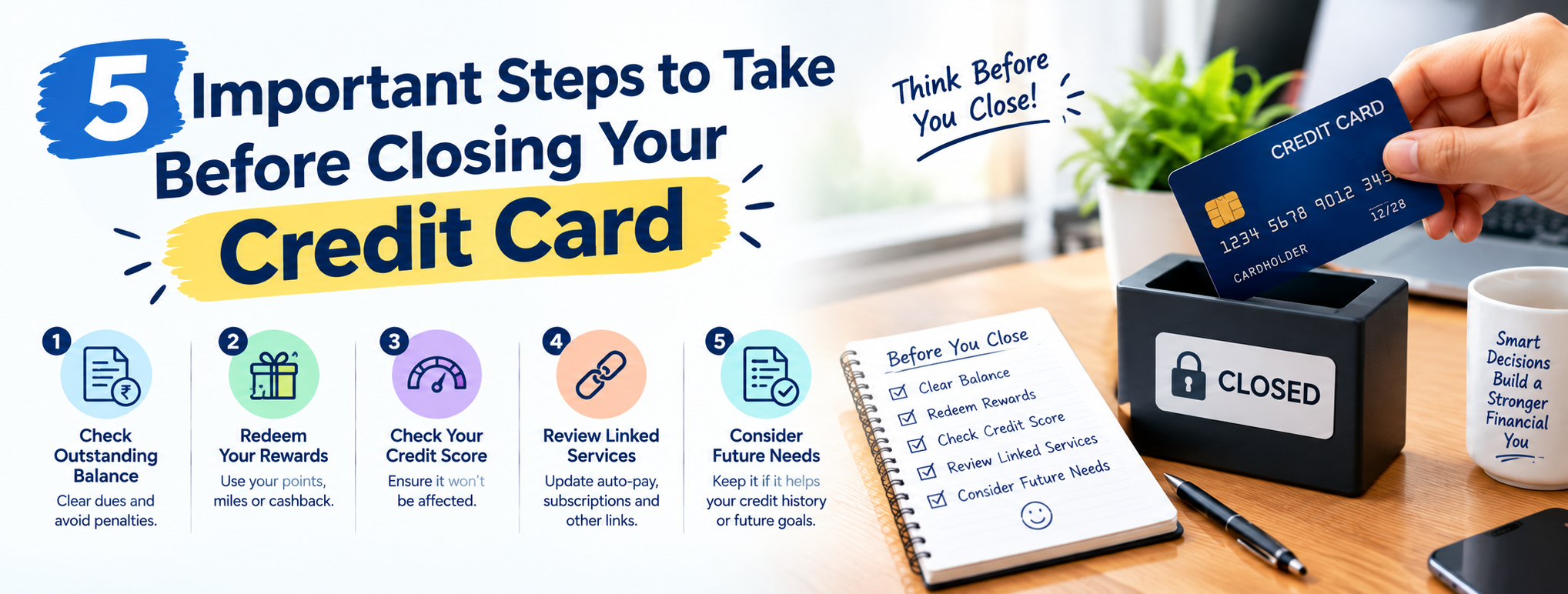
Planning to close your credit card? Learn the 5 important steps to take before closing a credit card to protect your credit score and avoid hidden charges.
Introduction
Closing a credit card sounds simple, call the bank, say you want to cancel, and you're done. But if you skip the right preparation, that one decision can quietly damage your credit score, cost you unused reward points, or leave you stuck with surprise charges months later.
Whether you're closing a card because of a high annual fee, too many cards in your wallet, or a switch to a better offer, knowing the things to do before closing a credit card can save you from financial headaches down the road. In this guide, we'll walk you through the five most important steps before you request a credit card closure, explain how it affects your credit score, and show you smarter alternatives worth considering first.
If you're based in Bangalore or anywhere in India and weighing your options between credit, personal loans, or a fresh credit card, this guide will help you make a financially sound call.
What Happens When You Close a Credit Card?
When you close a credit card, the bank deactivates the account and reports the closure to credit bureaus like CIBIL, Experian, and Equifax. This changes two things immediately:
- Your total available credit goes down, which can raise your credit utilization ratio.
- Your account history with that card stops growing, though it still shows on your credit report for several years.
This is exactly why the credit card closure process needs a bit of planning, not because closing a card is wrong, but because doing it carelessly can hurt your credit profile. For a deeper understanding of how these factors work together, check out our guide on what is a credit score and its role and importance.

5 Important Things to Do Before Closing a Credit Card
Before you pick up the phone or open the app to cancel your card, work through this checklist. Each step protects you from a different risk, financial, procedural, or credit-related.
1. Clear Your Outstanding Balance and Dues
This is the single most important step. Banks will not close a credit card account if there is an outstanding balance, and in some cases, if you stop using the card without formally closing it, interest and late fees can keep piling up on an account you think is already "done."
What to check before clearing dues:
- Your current outstanding balance, including any EMI conversions
- Pending transactions that haven't been billed yet
- Any annual fee or renewal charge due in the current cycle
- Foreign transaction charges if you used the card abroad recently
Once you clear the full balance, wait for your next statement to confirm a zero balance before requesting closure. If you cancel a credit card with an outstanding balance still being tracked, your closure request can get rejected or delayed, and the balance will continue to attract interest. If debt has built up on multiple cards, it may help to compare your options. Our article on personal loan vs credit card breaks down when switching high-interest credit card debt into a lower-interest personal loan makes more financial sense.
2. Redeem Your Reward Points and Benefits
Most people forget this step, and it costs them. When you close a credit card, any unused reward points, cashback, or air miles are usually forfeited immediately. Banks rarely transfer these to another account or pay them out in cash.
Before closing your card, check for:
- Unredeemed reward points or loyalty points
- Pending cashback that hasn't been credited yet
- Unused vouchers, lounge access, or milestone benefits
- Insurance covers (like purchase protection or travel insurance) tied to the card
Log in to your net banking or card app and redeem whatever you can, whether it's a statement credit, a gift voucher, or a straight cashback transfer. If you're unsure how your card's benefits compare to other options in the market, our roundup of the best credit cards in India 2026 is a useful reference if you're also considering a replacement card.
3. Check for Annual Fees, Cancellation Charges, and Hidden Costs
Many cardholders assume closing a card is free. In reality, some banks charge:
- A pro-rata annual fee if you close mid-cycle
- A card cancellation charge, especially on premium or co-branded cards
- Reactivation fees if you want to reopen the account later
Call your bank's customer care or check the latest Most Important Terms and Conditions (MITC) document for your card to understand the exact credit card closure charges. Asking this upfront avoids an unpleasant surprise on your final statement.
Quick Tip: Always ask for the closure charges in writing (email or chat transcript) before confirming your request. This becomes useful if there's a billing dispute later.
4. Understand the Impact on Your Credit Score
This is where most people get it wrong. Closing a credit card can affect your credit score in a few specific ways:
Credit Utilization Ratio
Your credit utilization is the percentage of your total available credit that you're using. When you close a card, your total credit limit drops, so if your spending stays the same, your utilization ratio after closing a credit card goes up. A higher utilization ratio (ideally kept under 30%) can lower your score.
Example:
Suppose you have two cards with a combined limit of ₹3,00,000, and you usually carry a balance of ₹30,000. Your utilization is 10%. If you close one card with a ₹1,00,000 limit, your available credit drops to ₹2,00,000, pushing your utilization to 15%. It's still manageable, but the math changes quickly if you have fewer cards or higher balances.
Length of Credit History
Older accounts contribute positively to your average account age, which is a factor in your credit score. Closing your oldest card can shorten your average credit history over time, even though the closed account stays on your report for a few years.
Credit Mix
Lenders like to see a healthy mix of credit types, credit cards, loans, EMIs. Closing your only credit card removes that mix entirely, which can have a small negative effect, especially if you plan to apply for a loan soon.
If you're planning any large purchase, business funding, or even a small business loan in the near future, it's worth timing your card closure carefully rather than doing it right before a loan application. You can also read our detailed breakdown on what lowers your credit score — 10 common mistakes to avoid compounding the impact.
5. Get Written Confirmation of Closure
Don't consider your credit card closed just because you spoke to a representative or submitted a request online. Always get:
- A closure confirmation letter or email from the bank
- Confirmation that the outstanding balance is zero
- A note that the account has been reported as "closed" (not settled) to credit bureaus
This distinction matters a lot. A card marked "closed" shows you paid off the balance in full and closed the account voluntarily. A card marked "settled" implies you paid less than what was owed, which is a major red flag on your credit report and can hurt your score far more than a simple closure. Always double-check your credit report a few weeks after closure to confirm the status was updated correctly.
Does Closing a Credit Card Hurt Your Credit Score?
Yes, closing a credit card can hurt your credit score, but the impact depends on a few factors:
- How many other cards or credit lines you have — closing one card out of several has a smaller effect than closing your only card.
- How old the card is — closing a card you've held for 8+ years has more impact than closing a card you got last year.
- Your utilization after closure — if closing the card pushes your utilization above 30%, expect a noticeable dip.
In most cases, the score drop is temporary and recovers within a few months if you keep your other accounts in good standing and continue paying on time. If you want a broader strategy to recover or improve your score after a card closure, our guide on how to improve your credit score fast covers practical, actionable steps.
Is It Good to Close a Credit Card? When It Makes Sense
Closing a card isn't always the wrong move. It can be a smart decision when:
- The annual fee outweighs the benefits you actually use
- You're struggling to manage multiple cards and want to simplify your finances
- The card has poor rewards or high interest compared to better options now available
- You've outgrown the card, for instance, moving from an entry-level card to a premium one
It may not be the best move when:
- It's your oldest card and closing it will significantly shorten your credit history
- You have high balances on other cards, and losing this credit limit will spike your utilization
- You're planning to apply for a loan or mortgage soon
- You still have unused benefits or rewards worth more than the annual fee
Alternatives to Closing a Credit Card
Before you finalize the cancellation, consider these alternatives, they often solve the same problem without the credit score risk.
- Downgrade the card — Many banks let you switch from a premium card to a no-fee or lower-fee variant, keeping your credit history and limit intact.
- Negotiate the annual fee — A quick call to customer care, especially if you've been a long-term customer, can often get the fee waived.
- Keep the card active with minimal use — Use it for a small recurring bill (like an OTT subscription) and set up auto-pay. This keeps the account active without the stress of usage.
- Request a credit limit adjustment — If overspending is the concern, lowering your credit limit is safer than closing the account entirely.
- Convert big expenses into EMIs — If high balances are the real issue, converting a large purchase into EMI, or exploring options like a personal loan, can reduce the pressure without touching your card's credit line. Even everyday purchases like electronics can be managed differently, see our guide on buying a laptop on EMI without a credit card for options that don't require closing anything.
How to Close a Credit Card: Step-by-Step Process
If you've weighed the alternatives and still want to proceed, here's the standard credit card cancellation process followed by most Indian banks:
- Clear your outstanding balance in full and wait for the next billing cycle to confirm a zero balance.
- Redeem all reward points, cashback, and benefits before initiating the request.
- Submit a closure request via net banking, the bank's app, customer care, or a written letter to the branch.
- Provide your card details and reason for closure if asked (this is usually optional).
- Destroy the physical card by cutting through the chip and magnetic strip once closure is confirmed, this prevents misuse even after cancellation.
- Request written confirmation of closure and the zero-balance status.
- Check your credit report after 30–45 days to confirm the account reflects as "closed" and not "settled" or "active."
This process typically takes 7 working days from the date of request, though it can extend if there are pending transactions or disputes.
Things to Check Before Closing a Credit Card: Quick Checklist
Use this as a final review before you submit your closure request:
- ✅ Outstanding balance is fully paid and confirmed as zero
- ✅ All reward points, cashback, and vouchers are redeemed
- ✅ Annual fees, renewal charges, or cancellation fees are clarified
- ✅ You understand the impact on your credit utilization and score
- ✅ You've considered alternatives like downgrading or fee waiver
- ✅ You have written confirmation of the closure request
- ✅ You've planned the timing (avoid closing right before a loan application)
If you're actively working on building or protecting your credit profile, it's worth reading our guides on how to improve your CIBIL score in India and, if you're just starting out, how to build credit from scratch in India. There are also a number of common credit score myths worth clearing up before you make any big decisions about your cards.
Frequently Asked Questions (FAQs)
1. What are the things to do before closing a credit card?
Clear your outstanding dues, redeem reward points and cashback, check for annual fees or cancellation charges, understand the credit score impact, and get written confirmation of closure once done.
2. Does closing a credit card hurt your credit score?
Yes, it can. Closing a card reduces your total available credit, which raises your credit utilization ratio, and may shorten your average account age, both of which can lower your score temporarily.
3. Can I close a credit card with an outstanding balance?
No. Banks require the full outstanding balance to be cleared before processing a closure request. Attempting to cancel a credit card with an outstanding balance will usually result in the request being rejected or delayed.
4. How long does the credit card closure process take?
Most banks in India complete the closure process within 7 working days of the request, provided there are no pending dues or disputes.
5. Is it better to close a credit card or keep it inactive?
Keeping a card active with minimal, occasional use (and auto-pay set up) is often better for your credit history than closing it, especially if it's one of your older cards. Downgrading to a no-fee variant is another good middle ground.
6. What happens to my reward points if I close my credit card?
In most cases, unused reward points, cashback, and benefits are forfeited immediately upon closure. Always redeem them before submitting your closure request.
Conclusion
Closing a credit card isn't just a quick phone call, it's a financial decision that affects your credit score, your rewards, and sometimes your wallet through hidden fees. By clearing your dues, redeeming your benefits, checking the charges, understanding the credit impact, and getting written confirmation, you can close your card the right way, without any surprises later.
If you're reassessing your credit cards as part of a bigger financial plan, FixRupee can help. Whether you need a personal loan to consolidate high-interest card debt or want to explore a credit card that better fits your spending, we've got options built for your needs.
Ready to take the next step toward better financial health? Start your loan application with FixRupee today and get a decision that works for you.