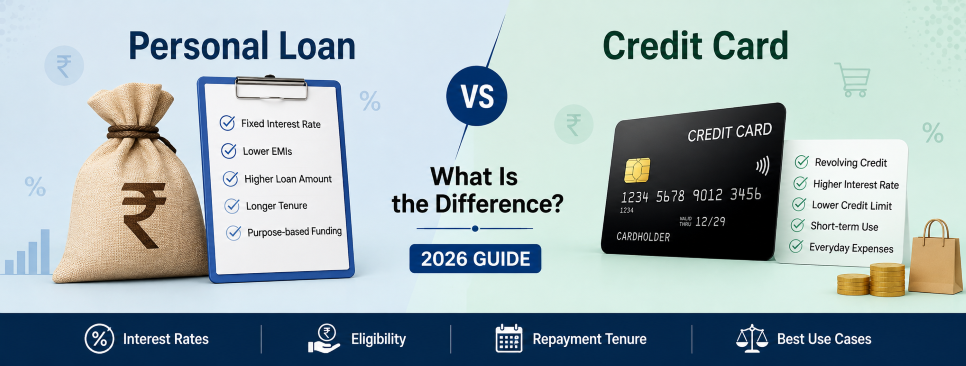
Confused between a personal loan vs credit card for your next big expense? Compare interest rates, EMI, credit score impact & more. Read now!
Introduction
You need money for a wedding, a medical bill, or a home renovation, and now you're stuck choosing between swiping your credit card or applying for a personal loan. It's one of the most common money dilemmas for borrowers in Bangalore and across India, and picking the wrong option can quietly cost you thousands of rupees in extra interest.
The truth is, personal loan vs credit card isn't a one-size-fits-all answer. Each product works differently, different interest rates, different repayment structures, and different effects on your credit score. In this guide, we'll break down exactly how a personal loan and a credit card compare on cost, EMI, tenure, and credit health, so you can make a confident, informed choice for your next expense.
What Is a Personal Loan?
A personal loan is an unsecured loan, meaning you don't need to pledge any collateral like property or gold, that banks and NBFCs disburse as a lump sum. You repay it over a fixed loan tenure (usually 12 to 60 months) through equal monthly instalments, or EMI.
Personal loans are typically used for:
- Medical emergencies
- Wedding expenses
- Home renovation
- Debt consolidation
- Large one-time purchases
Because the entire amount lands in your bank account at once, a personal loan works best when you know the exact amount you need upfront.
What Is a Credit Card?
A credit card is a revolving credit line issued by your bank up to a pre-approved credit limit. You can spend, repay, and spend again, as long as you stay within that limit. Every month, you get a statement, and you can either pay the full outstanding amount or just the minimum payment (usually 5% of the bill).
Credit cards are ideal for:
- Everyday spends and recurring bills
- Short-term purchases you can repay within the interest-free period (usually 20–50 days)
- Building purchase-level rewards or cashback
The catch: if you don't clear the full bill, the unpaid amount attracts very high interest — often starting the day of purchase.
Personal Loan vs Credit Card: Interest Rate Comparison
This is where most borrowers get caught off guard. Let's look at the numbers.
| Factor | Personal Loan | Credit Card |
|---|---|---|
| Interest Rate (Annual) | ~10.5% – 24% | ~30% – 46% |
| Interest-Free Period | None | Up to 45–50 days (on new purchases only) |
| Interest Calculation | On reducing balance | On full outstanding, often from purchase date |
| Processing Fee | 1% – 3% of loan amount | Usually nil, but annual/joining fees may apply |
A personal loan vs credit card interest rate comparison consistently favors the loan for planned, large expenses. Credit card interest, when calculated as APR (Annual Percentage Rate), can cross 40% per year if you're carrying a balance, nearly double what most personal loans charge.
Real-world example: If you borrow ₹2,00,000 for a home renovation:
- On a personal loan at 13% p.a. for 3 years, your total interest cost is roughly ₹43,000.
- On a credit card at 36% p.a. (typical for revolving balances), carrying the same amount for 3 years, even with partial payments, can push your total interest cost above ₹1,50,000.
That gap is exactly why lenders and financial advisors recommend a personal loan for large expenses rather than letting them sit on a credit card.
Personal Loan EMI vs Credit Card EMI
Both products now offer EMI-style repayment, but they work very differently under the hood.
How Personal Loan EMI Works
- Fixed EMI amount for the entire tenure
- Calculated on the reducing balance method
- Interest rate is locked in at disbursal (for fixed-rate loans)
- Predictable, you know exactly what you'll pay each month until closure
How Credit Card EMI Works
- Your bank converts a large purchase (or your outstanding bill) into EMIs
- Comes with a processing fee (typically 1–3%) plus GST
- Interest rates on credit card EMI conversions (12–24% p.a.) are usually higher than a standard personal loan
- If you miss even one EMI, you may lose promotional pricing and get charged standard credit card interest
So, when comparing personal loan EMI vs credit card EMI, the personal loan usually wins on transparency and total cost, especially for amounts above ₹50,000 or tenures longer than a year. Credit card EMI vs personal loan EMI conversions can make sense only for very short tenures (3–6 months) on already-approved limits.
Impact on Credit Score
Your credit score is directly shaped by how you use both these products, but in different ways.
Credit Card and Credit Utilization
Card usage affects your score mainly through credit utilization, the percentage of your credit limit you're using. Experts generally recommend keeping this under 30%. Maxing out your card, even if you pay on time, can drag your score down because it signals higher risk to lenders.
Personal Loan and Credit Mix
A personal loan is an installment loan, and repaying it on time helps build your credit mix (a blend of secured, unsecured, revolving, and installment credit), which lenders view favorably. It also doesn't carry the utilization-ratio risk that cards do.
In a personal loan vs credit card credit score comparison:
- Missed credit card payments hurt fast, interest compounds and your utilization spikes
- Missed personal loan EMIs also hurt, but the fixed schedule makes it easier to plan around
- A healthy mix of both, used responsibly, generally builds the strongest credit profile over time
If your score isn't where you'd like it to be, it's worth checking where you stand before applying for either. You can check your free credit score on FixRupee in a few minutes, and if you're wondering how scores are calculated or updated, this guide on free credit score checks in 2026 breaks it down in detail.
Credit Card Debt vs Personal Loan: Which Is Better for Repaying Existing Debt?
If you're already carrying credit card debt, this comparison changes shape. Here, the question isn't "which to use for a new expense" but "how do I get out of this debt efficiently."
This is where debt consolidation comes in. Rolling multiple high-interest credit card balances into a single personal loan can:
- Cut your effective interest rate significantly (from 30–46% down to 10–24%)
- Replace multiple due dates with one fixed EMI
- Give you a clear payoff date instead of an open-ended revolving balance
- Simplify your monthly budgeting
Credit card debt vs personal loan, for consolidation purposes, a personal loan is almost always the more cost-effective route, provided you qualify for a competitive rate.
Personal Loan vs Credit Card: Which Is Better?
There's no universal winner, it depends on the size, urgency, and nature of your expense.
Choose a Personal Loan When:
- You need a large, one-time amount (typically above ₹50,000)
- You want a fixed EMI and a clear end date
- You're consolidating existing high-interest debt
- You want a lower borrowing cost overall
Choose a Credit Card When:
- The expense is small and you can repay within the interest-free period
- You need flexible, repeated access to funds
- You want to earn rewards, cashback, or points on spends
- It's a genuine emergency and you need funds instantly, before a loan can be processed
Quick decision checklist:
- Can I repay this within 45 days? → Credit card is fine.
- Is the amount large and one-time? → Personal loan.
- Am I already carrying card debt? → Personal loan for consolidation.
- Do I need funds in the next few hours? → Credit card, then consider transferring the balance to a personal loan later.
What If Your Credit Score Isn't Strong Enough?
A common concern for many borrowers is qualifying for a personal loan when their score isn't ideal. The good news: it's still possible. Lenders look at more than just your score, income stability, existing obligations, and repayment history all matter too. If this applies to you, this guide on getting a personal loan with a low credit score walks through practical steps to improve your approval odds. It's also worth knowing the minimum CIBIL score required for a personal loan before you apply, so you're not caught off guard during the process.
Conclusion: Making the Right Choice Between Personal Loan and Credit Card
When it comes to personal loan vs credit card, the smartest borrowers don't pick one over the other permanently, they match the right tool to the right expense. Use your credit card for short-term, manageable spends you can clear within the interest-free window. Turn to a personal loan when you're facing a large expense, want predictable EMIs, or need to consolidate expensive credit card debt into one affordable payment.
Before you decide, check your credit score, compare your total borrowing cost (not just the EMI), and choose the option that keeps more money in your pocket over time.
Ready to compare your options? Apply for a personal loan with FixRupee and get a quick eligibility check, competitive interest rates, and a repayment plan that actually fits your budget.
FAQs
1. Is a personal loan cheaper than a credit card?
Yes, in most cases. Personal loan interest rates typically range from 10.5% to 24% per year, while credit card interest on unpaid balances can go as high as 40–46% annually.
2. Can I use a personal loan to pay off credit card debt?
Yes. This is called debt consolidation. You take a personal loan to clear your credit card balance, then repay the loan through fixed, lower-interest EMIs instead of high-interest revolving debt.
3. Does taking a personal loan affect my credit score?
Yes, both positively and negatively. Timely EMI payments build a strong repayment history and improve your credit mix. Missed payments, on the other hand, can lower your score.
4. Which is better for a medical emergency, personal loan or credit card?
For instant, smaller amounts, a credit card can work since funds are already available. For larger medical expenses, a personal loan is usually more affordable due to its lower interest rate, though disbursal may take a bit longer.
5. What credit score do I need for a personal loan?
Most lenders prefer a score of 700 and above, though approval also depends on income and existing debt. Check the specific minimum CIBIL score requirements for more clarity.
6. Is credit card EMI better than a personal loan EMI?
For very short tenures (3–6 months) on amounts already within your credit limit, credit card EMI can be convenient. For larger amounts or longer tenures, a personal loan EMI is usually cheaper overall.